
Patent lawyers charge about $380 an hour on average, or $8,000 to $15,000+ as a flat fee to draft and file a standard utility patent. Complex inventions cost more. USPTO fees are separate starting from $400 for micro entities and depend on application type, entity status and claim count.
There’s an uncomfortable truth about patent lawyers that no one tells you upfront: The cost isn’t the scary part. What you get for it, or don’t, is.
You may have an idea worth protecting. Understanding patent attorney cost means weighing the fee against the scope and strength of the work.
Here’s the real breakdown.
The Short Answer: What Does a Patent Lawyer Cost?
Patent lawyer price depends on the invention, the work included and the professional you hire. These planning ranges cover attorney fees only, not USPTO fees, drawings, searches or later prosecution work. The hourly figure below comes from the 2023 AIPLA economic survey and is not a verified 2026 national average.
| Patent type / task | Typical attorney fee | What affects the price |
| Utility patent, standard mechanical/software | 8,000–15,000+ | Complexity, claims, drawings and prosecution scope |
| Utility patent, complex AI/biotech/engineering | 15,000–25,000+ | Technical depth, data, claims and revisions |
| Design patent application | 2,000–4,000 | Number and complexity of views; confirm quote |
| Attorney hourly rate | $439 national IP-law average reported in AIPLA 2023 survey | Firm, seniority, location and specialty |
Attorney fees only. USPTO fees and other costs are extra.
Sources: 2023 Report of the Economic Survey and published 2026 attorney fee schedules; ranges vary by provider.
How Much Does a Patent Attorney Cost?
A patent attorney cost estimate may be hourly or fixed-fee. The 2023 Report of the Economic Survey is a useful published benchmark, while firm pricing pages show that individual quotes vary. The city figures below are planning ranges from public pricing guides, not official averages for patent attorneys.
| City / market | Indicative hourly range | Source / limitation |
| New York | 400–800+ | Published 2026 IP-law cost guide; varies by firm and work type |
| San Francisco | 400–800+ | Published 2026 IP-law cost guide; varies by firm and work type |
| Detroit | 300–600 | No reliable city-specific patent-attorney rate benchmark found; yellow means verify |
| Austin | 300–600 | Broad IP-law guide estimate, not a patent-specific local survey |
A junior associate or patent agent may cost less per hour than a senior attorney. Compare the estimated total for the same scope, not only the hourly rate.
Patent Attorney Fees: Flat Fee vs Hourly vs Retainer
Patent attorney fees are commonly billed as a flat fee for a defined filing stage, hourly for work that is difficult to predict, or through a retainer for ongoing support. Ask what the quote includes, which later stages are excluded and how additional work is approved.
| Fee type | How it works | Best for | Watch out for |
| Flat fee | Fixed price for a defined stage | A standard application with a clear scope | Office actions, drawings or filing fees may be extra |
| Hourly | Billed for time spent | Searches, advice and unpredictable prosecution | Total cost can grow |
| Retainer | Funds paid in advance and drawn down | Ongoing portfolio work | Ask about replenishment and unused balance rules |
Office action responses are often billed separately. One published 2026 fee schedule lists 1,300–2,500 in attorney fees per response; actual quotes depend on the examiner’s objections and the work required.
Patent Lawyer vs Patent Attorney vs Patent Agent: Is There a Price Difference?
“Patent lawyer” and “patent attorney” generally refer to a lawyer qualified to practice before the USPTO in patent matters. A patent agent is registered to practice before the USPTO but is not a lawyer. Agents can handle patent prosecution, but they cannot provide legal services reserved for attorneys.
Consider a patent agent if:
You mainly need technical patent drafting or prosecution.
You do not need broader legal advice on contracts, licensing disputes or litigation.
Why Patent Lawyers Charge What They Charge
When you hire a registered patent attorney, you’re not paying for paperwork.
- Technical analysis
- Legal strategy
- Claim drafting precision
- Risk mitigation
- Navigation of the United States Patent and Trademark Office (USPTO)
Patent law blends engineering and law. Few professionals are trained in both.
That drives prices.
What Impacts Patent Lawyer Cost?
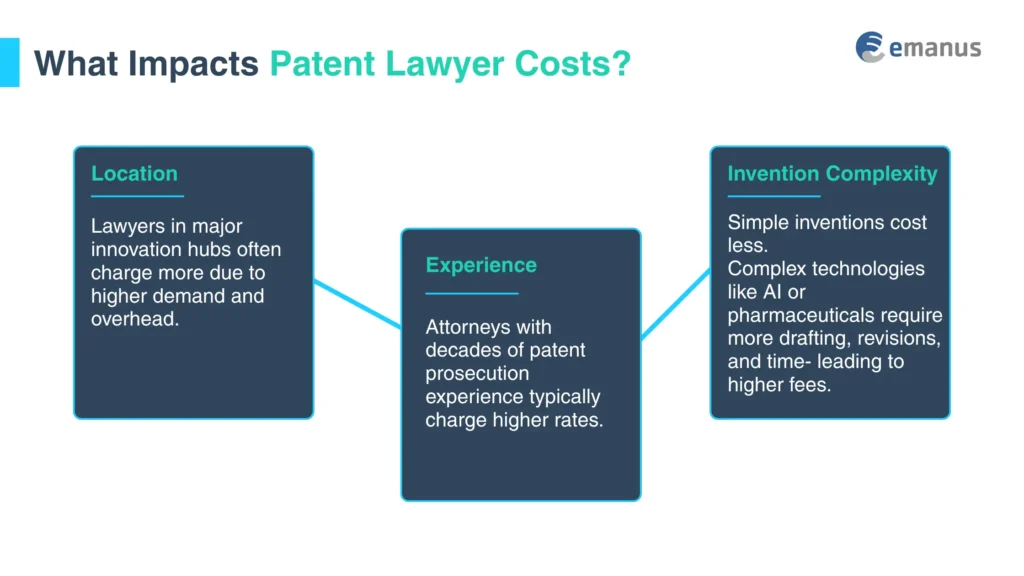
- Location
Attorneys in major innovation hubs charge more due to demand and overhead. A Detroit patent attorney, for example, may offer competitive pricing compared to coastal markets.
- Experience Level
A senior patent attorney with 20 years of prosecution experience commands higher rates.
- Invention Complexity
Simple mechanical tools cost little. With complex inventions like AI architecture or pharmaceutical compounds, expect more time, more drafting layers, more revisions and higher fees.
Patent Cost by Stage: Attorney Fees and USPTO Fees
The total cost of a patent includes attorney fees, USPTO filing and examination fees, and extras such as searches and drawings. Costs may continue after filing through office action responses, an issue fee and maintenance fees. Government charges depend on entity status and application details.
| Stage | Attorney / service cost | USPTO fee |
| Prior art search | 500–1,000 (professional search estimate; provider varies) | Usually separate from application fees |
| Drafting and filing | 8,000–15,000+ standard utility; 15,000–25,000+ complex | Filing + search + examination fees |
| Drawings | 300–500 per drawing (estimate; complexity varies) | No standard drawing fee |
| Office action response | 1,300–2,500 per response (published 2026 example) | RCE fee may apply if continued examination is requested |
| Issue / grant | Attorney handling fee varies; request quote | Utility issue fee: $1,290 large / $516 small / $258 micro |
| Maintenance | Attorney handling fee varies; request quote | Due at 3.5, 7.5 and 11.5 years |
USPTO fees only. Attorney fees are charged on top. The USPTO fee schedule was checked in October 2026.
Source: USPTO fee schedule
| USPTO fee | Large entity | Small entity | Micro entity |
| Utility filing + search + examination total* | $2,000 | $730 | $400 |
| Design filing + search + examination total | $1,300 | $520 | $260 |
| Provisional filing fee only | $325 | $130 | $65 |
| Utility issue fee | $1,290 | $516 | $258 |
| Maintenance at 3.5 years | $2,150 | $860 | $430 |
| Maintenance at 7.5 years | $4,040 | $1,616 | $808 |
| Maintenance at 11.5 years | $8,280 | $3,312 | $1,656 |
| First request for continued examination (RCE) | $1,500 | $600 | $300 |
| Each independent claim over 3 | $600 | $240 | $120 |
| Each claim over 20 | $200 | $80 | $40 |
| Non-DOCX filing surcharge | $430 | $172 | $86 |
*Utility small-entity total uses the $70 electronic filing fee shown by the USPTO for small entities, plus the small-entity search and examination fees. Confirm eligibility and current fee schedule before filing.
How Much Does a Provisional Patent Cost With an Attorney?
A provisional patent application costs $65 for a micro entity, $130 for a small entity or $325 for a large entity in USPTO filing fees. Attorney drafting is extra. One published 2026 fee schedule lists 1,700–3,300 for attorney work, while other firms charge more depending on technical complexity.
A provisional application can establish a filing date and is generally pending for 12 months.
It is not an issued patent and is not examined on its merits.
To pursue the benefit of the provisional filing, you generally need a corresponding nonprovisional application within that 12-month period.
If you are considering phased filing, compare the provisional’s scope with the later application before treating it as a low-cost placeholder.
For a detailed breakdown of provisional patent costs: Provisional Patent Application: Costs & Filing Guide 2026
The Real Risk: What Happens If You Cut Corners?
A weak patent can be worse than no patent if its claims fail to protect the invention you need to commercialize. Patent litigation can cost hundreds of thousands of dollars or more, depending on the stakes and stage reached. The 2023 Report of the Economic Survey reports median litigation costs by dispute value and litigation stage; it does not support one universal price for every lawsuit.
Suddenly, saving money upfront may not look so smart. Compare the cost of drafting carefully with the commercial value of the protection you need.
Do You Actually Need a Patent Lawyer?
Legally? No. You can file pro se (on your own).
Strategically? Usually yes.
Patent law is procedural and technical. Mistakes can permanently narrow your protection. Once filed, you cannot add new subject matter later.
If your invention matters commercially, professional guidance dramatically improves your odds.
Can You Reduce Patent Costs Strategically?
If you’re smart, yes you can.
Prepare Before Consultations
The more prepared you are with descriptions, prior art and diagrams, the fewer billable hours you burn.
Compare Multiple Attorneys
Don’t choose based solely on price. Evaluate:
Technical background
Industry experience
Success rate
Communication style
Consider Phased Filing
Start with a provisional patent application (lower upfront cost), then invest in a full utility application once the market validates your idea.
Self-Filing: The Pros and Cons
Pros:
Lower upfront cost
Total control
Educational experience
Cons:
Time-consuming
High risk of technical mistakes
Limited strategic insight
Lower quality claims
Self-filing can work for simple inventions, but high-value innovations deserve careful attention.
Patent Attorney vs DIY: Cost Comparison
Filing yourself can reduce upfront professional fees, but you still pay applicable USPTO fees and take responsibility for preparing the application. Hiring an attorney adds cost but may help with claim strategy, formal requirements and responses during examination.
| Factor | With a patent attorney | Filing yourself (pro se) |
| Upfront cost | About 8,000–15,000+ for standard utility drafting and filing, plus USPTO fees | USPTO fees plus any search, drawings or tools you purchase |
| Claim quality | Professional drafting and strategy; no guarantee of scope or grant | Depends on your patent knowledge and drafting skill |
| Risk of costly mistakes | Professional review can reduce some risks, not eliminate them | You are responsible for requirements and deadlines |
| Typical total to grant | Can exceed initial quote if office actions or extra work arise | Government fees plus your time and any later professional help |
Is a Patent Lawyer Worth It?
A patent lawyer is worth considering when the invention has commercial value, complex technology or licensing potential. Strong drafting takes planning because new subject matter generally cannot be added after filing.
A DIY approach may suit a simple, low-value invention if you understand the process and accept the risks.
- Hire an attorney if the claims, market value or future licensing plans are important.
- Consider DIY only if the invention is straightforward and you can prepare a compliant application.
- Ask for a written scope covering drafting, filing, office actions, drawings and government fees.
Frequently Asked Questions (FAQs)
How much does a patent attorney cost?
A standard utility patent application often costs about 8,000–15,000+ in attorney fees, while complex AI, biotech or advanced engineering work may reach 15,000–25,000+. A design patent may cost about 2,000–4,000. USPTO fees, drawings, searches and office action responses can add to the total.
What is the average cost of a patent lawsuit?
Patent litigation can cost hundreds of thousands of dollars or more. The AIPLA 2023 Economic Survey reports median litigation costs by the amount at risk and the stage reached, so a single range does not fit every case. Costs depend on discovery, claim construction, trial, appeal and whether the dispute settles.
What are the 5 requirements for a patent?
A U.S. invention generally must involve patent-eligible subject matter, be novel, be non-obvious, be useful, and be described in enough detail for a skilled person to make and use it. The exact legal analysis depends on the invention and application. The USPTO examines applications under the applicable patent laws and rules.
Do you need a lawyer to patent an idea?
No. Inventors can file a patent application themselves, a process called filing pro se. A registered patent attorney or agent can help prepare the application and respond to examination issues. Professional help may be especially useful when the invention is complex or commercially important.
Can I sell my idea without a patent?
Yes, but consider confidentiality and business risks before disclosing it. A patent is not the only way to protect commercial value, and public disclosure can affect patent options, especially outside the United States. Consider legal advice before sharing enabling details with potential buyers, manufacturers or investors.
Can ChatGPT write a patent?
AI tools can help organize technical notes, explain terminology or prepare a first-pass description. They can also make errors, miss prior art or produce claims that do not protect the invention properly. Do not treat AI output as a substitute for review by a qualified patent professional.
What is the average patent attorney hourly rate?
The AIPLA 2023 Economic Survey is cited by a published 2026 attorney fee schedule as reporting a national average hourly cost of about $439. That is a benchmark, not a guaranteed 2026 quote. Rates vary by city, seniority, technical field and firm size. See the city-rate table above for indicative ranges.
How much does a provisional patent cost?
The USPTO provisional filing fee is $65 for a micro entity, $130 for a small entity or $325 for a large entity. Attorney drafting is additional. One published 2026 fee schedule lists 1,700–3,300 for the attorney work, but complex inventions and other providers may cost more.
Is a patent lawyer worth it?
Often, yes, if the invention has commercial value or the claims need careful technical and legal drafting. A lawyer cannot guarantee a patent will be granted, but professional guidance may help avoid preventable errors. For a simple, low-value idea, DIY filing may be an option if you understand the process.
Final Thoughts
Patent lawyer cost in 2026 comes down to one question: How seriously do you take your innovation?
You can treat it like a gamble, cutting corners and hoping for the best. Or you can treat it like the asset it is by investing strategically in protection that compounds in value.
Twenty years starts now. The first six months will shape every one of them.
Before choosing a filing route, map the invention, likely market and budget, then compare the full scope of each quote. Book a free consultation Expert Patenting & Licensing Services by Emanus to discuss patent filing options.