If you have an invention you want to patent, you do not necessarily need a patent attorney to handle every step of the USPTO process. A registered patent agent can be the right fit when you need technical patent expertise to prepare and prosecute a U.S. patent application.
A patent agent can help translate your invention into a patent application, define what should be protected, respond to USPTO objections, and navigate the procedures that determine whether the application can become an issued patent.
For inventors who are unsure how to protect a technically complex invention, are preparing their first patent application, or need help responding to USPTO examination, a patent agent can provide practical value by handling the technical and procedural work involved in patent prosecution.
What does a patent agent do?
A patent agent helps inventors prepare, file, and prosecute patent applications before the USPTO. Their work can include analyzing inventions, conducting prior-art searches, drafting patent applications and claims, filing responses to USPTO office actions, and communicating with patent examiners.
The USPTO maintains a register of practitioners authorized to practice in patent matters before the Office.
A patent agent can help with:
- Patentability analysis
- Prior-art research
- Patent application drafting
- Patent claims
- USPTO filings
- Office-action responses
- Examiner interviews
- Amendments to applications
- Patent prosecution strategy
- Decisions about continuing or abandoning an application
A patent agent’s authority is limited to the scope of patent practice before the USPTO and services reasonably connected with that practice. It does not give the agent the broader authority of a licensed attorney to practice law generally.
What is the difference between a patent agent and a patent attorney?
The main difference is that a patent attorney is a lawyer who is also registered to practice patent matters before the USPTO, while a patent agent is registered to practice patent matters before the USPTO but is not a lawyer.
| Patent Agent | Patent Attorney | |
| Technical/scientific qualifications | Required | Required for patent practice |
| USPTO registration exam | Required | Required |
| Can prepare patent applications | Yes | Yes |
| Can prosecute applications before USPTO | Yes | Yes |
| Can respond to office actions | Yes | Yes |
| Can represent clients in patent litigation | No | Yes |
| Can provide broader legal services | No | Yes |
| Must attend law school | No | Yes |
| Must pass a state bar | No | Yes |
If the immediate objective is preparing and prosecuting a U.S. patent application, a registered patent agent can perform much of the relevant work.
If the matter involves litigation, licensing agreements, broader legal advice, business transactions, or disputes outside USPTO patent practice, an attorney may be necessary.
How do you become a patent agent in 2026?
To become a U.S. patent agent, an individual must meet the USPTO’s scientific and technical requirements, satisfy character requirements, and pass the USPTO registration examination.
The USPTO registration examination is officially called the Examination for Registration to Practice in Patent Cases Before the United States Patent and Trademark Office. The computer-delivered exam contains 100 multiple-choice questions, of which 90 are scored, and candidates must correctly answer at least 63 scored questions to pass.
The candidate also needs qualifying scientific or technical education or experience.
What degrees qualify you to become a patent agent?
The USPTO uses several categories for demonstrating scientific and technical qualifications.
Category A covers specified scientific and engineering degrees.
Category B covers certain other degrees where the applicant has completed prescribed scientific or technical coursework.
Category C can apply where an applicant demonstrates qualifying practical engineering or scientific experience.
There is an important 2026 update: in August 2026, the USPTO expanded Category A to expressly include biomedical science.
Someone interested in how to become a patent agent should check the current USPTO General Requirements Bulletin Office of Enrollment and Discipline (OED).
How much does a patent agent cost in 2026?
There is no single standard patent-agent fee. The cost depends on the invention’s complexity, the type of application, the amount of prior-art work required, the drafting effort, and how much prosecution is needed after filing.
Patent costs also include USPTO government fees, which are separate from professional fees.
The USPTO’s 2026 fee schedule includes filing, search, examination, issue, maintenance and other fees. Small entities generally receive a 60% reduction on qualifying patent-related fees, while micro entities generally receive an 80% reduction on qualifying fees. Eligibility and the specific fee involved determine whether a reduction applies.
A useful way to think about the total cost is:
Patent agent fee + USPTO fees + additional prosecution costs = total patenting cost
| Cost category | What it covers |
| Patent agent professional fee | Research, drafting, filing and prosecution |
| USPTO filing/search/examination fees | Government processing |
| Additional claim fees | Certain applications with additional claims |
| Office-action response | Professional work after examination |
| Issue fee | Paid if the patent is allowed |
| Maintenance fees | Required at specified intervals after grant |
When should you hire a patent agent?
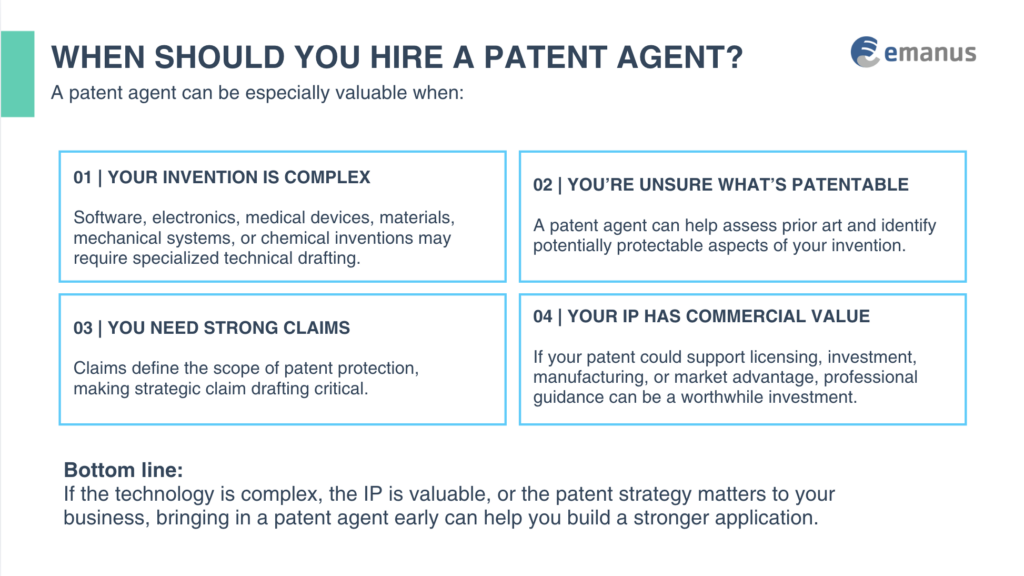
A patent agent can be particularly useful when you need professional help navigating the patent process before the USPTO.
You may want to hire one when:
- Your invention is technically complex.
Software, electronics, medical technology, materials, mechanical systems and chemical inventions often require precise technical drafting. - You are unsure what is actually patentable.
A patent agent can evaluate the invention against relevant prior art and identify potentially protectable technical features. - You need claims drafted strategically.
The claims define the legal scope of a patent, making claim drafting one of the most consequential parts of the application. - You need help responding to the USPTO.
If an examiner raises objections or rejections, a patent agent can prepare responses, make appropriate amendments, and communicate with the examiner as part of patent prosecution. - The invention is commercially important.
If the patent could support licensing, investment, manufacturing, or market differentiation, professional preparation can be worth the cost.
The practical value is not simply having someone file paperwork. A good patent agent helps translate technical innovation into a patent application, navigate examination, and make prosecution decisions within the scope of patent practice before the USPTO.
When should you hire a patent attorney instead?
A patent attorney becomes relevant when the matter extends beyond ordinary USPTO patent prosecution.
You may need an attorney when dealing with:
- Patent infringement litigation
- Licensing agreements
- Patent ownership disputes
- Complex transactions
- Legal opinions involving broader liability
- Litigation strategy
- Patent disputes outside ordinary examination
A patent agent may handle services connected to patent practice before the USPTO, but that does not make the agent a general legal or business adviser.
How do you choose the right patent agent?
The best patent agent is not simply the person with the lowest fee. Look for someone who understands both the invention’s technology and the applicant’s commercial objectives.
Use this checklist before hiring.
Technical fit
- Does the agent understand your technology?
- Have they handled similar inventions?
- Can they explain your invention back to you clearly?
Patent experience
- Are they currently registered with the USPTO?
- How much experience do they have with patent prosecution?
- Do they regularly handle office actions and examiner interviews?
Strategic fit
- Do they understand what you want the patent to accomplish?
Communication
- Who actually drafts the application?
- How often will you receive updates?
- What happens if the USPTO raises objections?
The USPTO maintains a public directory where inventors can search for registered patent practitioners.
Conclusion
A registered patent agent is a USPTO-registered professional who combines technical knowledge with specialized patent-procedure expertise. They can prepare and prosecute patent applications before the USPTO and provide services reasonably connected to that practice, but they do not have the broader legal practice authority of patent attorneys.
A good patent agent brings more than technical knowledge. Their experience can shape how effectively an invention is protected and prosecuted.
Want to know what that expertise looks like? Learn about Why Inventors Trust Patent Agent Wil Jacques: A Founder’s Story – Emanus, his approach to working with inventors, and whether his experience is the right fit for your IP journey.
Related Questions
Is it difficult to become a patent agent?
Yes. Becoming a patent agent requires a qualifying scientific or technical background, meeting USPTO requirements, and passing the patent bar exam.
How much does a patent agent make per hour?
Patent agent hourly earnings vary based on experience, technical specialty, location, and whether they work independently or for a firm. Independent agents may charge different professional rates than salaried agents.
Do you need a degree to be a patent agent?
Generally, yes. You need qualifying scientific or technical education or another USPTO-approved qualification pathway to become a registered patent agent.
What do patent agents do?
Patent agents research prior art, draft patent applications and claims, file applications, respond to USPTO office actions, and help inventors navigate patent prosecution.