
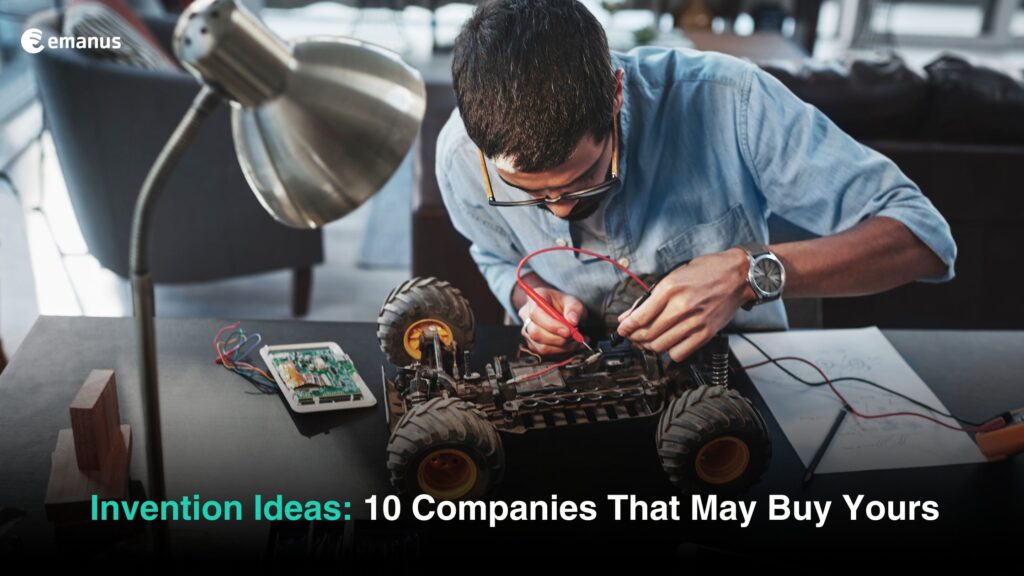
Got an invention but no factory, funding, or route to market? You may not need to build it alone.
Some companies work with independent inventors to develop, license, and commercialize new products. If you’re exploring invention ideas or looking for invention suggestions that could become marketable products, finding the right company is an important first step.
We’ve identified 10 companies, their areas of interest, and what inventors should know about getting their ideas considered. Whether you want to sell your idea, license it, or find a development partner, this guide will help you explore your options.
Important: These are companies and programmes to investigate, not ten guaranteed buyers.
At a Glance
The following table gives you a starting point for comparing companies before exploring their submission processes in detail.
| Company | Relevant invention categories | Submission model | What is known about compensation? |
| Invention City | Consumer products across multiple categories | Invention review, licensing, and representation | Licensing royalties or revenue-sharing arrangements may be offered |
| FastCap | Woodworking tools and professional hardware | Direct inventor submissions | 2%–5% royalty range under its stated terms |
| Henkel | Hair care, laundry, home care, adhesives and sustainable materials | Open innovation submissions | No fixed rate is published |
| Jokari | Household gadgets and consumer products | Inventor submissions managed through Davison | Licensing opportunities; no standard rate is published |
| Dorman Products | Automotive replacement and repair products | New Product Idea submission form | Contest rules and submission terms apply |
| BD | Medical devices and healthcare technologies | Patent or patent-pending invention submissions | No standard payment terms are published |
| Colgate-Palmolive | Oral care, personal care, home care, pet care and packaging | Open innovation portal | Commercial terms depend on further discussions and agreements |
| Haleon | Consumer healthcare and related technologies | Innovation portal and potential collaboration | Terms are developed if a suitable collaboration progresses |
| Procter & Gamble | Consumer products, technologies and packaging | Connect + Develop innovation portal | Depends on the proposed commercial opportunity |
| Stanley Black & Decker | Power tools, security technology and outdoor products | Open innovation submissions | Commercialization may be considered for selected submissions |
1. Can Invention City Help You License Your Product Idea?
Invention City is worth considering if you have a consumer product concept and want to explore a licensing arrangement without manufacturing the product yourself. It may also be relevant if you’re looking for invention idea help towards commercialization.
According to its official Licensing and Development Programme, the company considers invention suggestions and may offer either a licensing deal or a representation arrangement.
Its current published information describes a $185 submission fee. If it accepts an invention, the company may:
- License the invention and pay royalties.
- Represent the invention to potential licensees and share revenue.
- Recommend further development, prototyping, or patent protection where necessary.
The royalty percentage and revenue-sharing arrangements depend on factors such as the invention’s development stage, patent protection, competition, risk, and investment requirements.
What should inventors consider?
A paid submission is not a guaranteed licensing deal. Review the conditions of any proposed agreement before proceeding.
2. Does FastCap Pay Royalties for New Invention Ideas?
FastCap is one of the companies that pay for invention ideas developing woodworking tools, hardware, and products that improve the work of professional tradespeople.
Its official Submit an Idea page explains its approach to working with independent inventors.
FastCap publishes a royalty range of 2% to 5%, calculated on the actual price at which FastCap sells the product to distributors, rather than the distributor’s final retail price.
Its published submission information also states that:
- Royalties are paid monthly.
- The company does not pay upfront advances.
- A patent is not required to submit an idea.
- FastCap may pursue patent protection if it believes doing so will benefit product development.
- It focuses on unique innovations rather than improvements to existing ideas that do not meet its criteria.
3. Does Henkel Accept Invention Ideas From Independent Innovators?
Henkel’s Open Innovation programme invites external innovators to submit solutions relevant to its consumer product businesses.
Its current Open Innovation identifies several priority areas:
- Novel hair technologies.
- Laundry and home care technologies.
- Sustainable ingredients and packaging.
- Other solutions that fit its innovation priorities.
This is a useful opportunity for inventors working on materials, ingredients, formulations, product technologies, and sustainable packaging.
Henkel provides submission routes for specific innovation challenges rather than relying solely on general product suggestions.
What about compensation?
Henkel describes its approach as rewarding innovators with a fair share of the value created. However, it does not publish one fixed royalty percentage or payment amount for all submissions.
Inventors should therefore establish the commercial terms, ownership arrangements, and scope of collaboration during the evaluation process.
4. Can You License Your Invention Through Jokari?
Jokari has a long history of working with external inventors and licensing consumer product ideas.
Its official Inventors page explains that it works with Davison, an external company that manages the idea submission process and confidentiality arrangements.
Jokari also states that it holds scheduled invention review meetings with Davison’s licensing department.
This makes Jokari relevant for inventors exploring invention suggestions for household gadgets, storage solutions, and other consumer products.
How should you submit?
Jokari specifically asks inventors not to include the invention’s name, description, or technical details in the initial contact form. The company uses that first step to establish contact and direct the submission process.
Follow the company’s actual submission instructions rather than sending detailed invention disclosures through an ordinary contact form.
5. Does Dorman Products Consider New Automotive Invention Ideas?
Dorman Products accepts new product ideas relating to its automotive product categories through an official New Product Idea submission form.
It is a relevant option for inventors who have developed solutions to common automotive repair or replacement problems.
What should you prepare?
A useful proposal should explain:
- The automotive problem being addressed.
- The vehicle or product category involved.
- How the proposed solution improves on existing products.
- Why the solution could be useful to repair professionals or vehicle owners.
6. Can Inventors Submit Medical Device Ideas to BD?
BD, formerly known as Becton, Dickinson and Company, develops medical devices and healthcare technologies.
Its intellectual property submission policy is more restrictive than a general open innovation portal. According to BD’s published Terms of Use, it accepts certain external invention ideas when they are covered by existing patents or patent applications filed by the submitter.
BD also provides a formal new product idea consideration policy which asks inventors to provide detailed information, including:
- The problem the invention addresses.
- Its intended function and field of use.
- Advantages over existing products.
- Estimated manufacturing costs and market potential.
- Patent status and development stage.
- Whether a working model or prototype is available.
7. Does Colgate-Palmolive Have an Open Innovation Programme?
Colgate-Palmolive operates an Open Innovation Submission Portal which invites innovators to submit developed technical solutions that address the company’s strategic challenges.
Its focus areas include:
- Oral care.
- Personal care.
- Home care.
- Pet care.
- Packaging.
For inventors exploring invention ideas in consumer care, packaging, and related technologies, the portal offers a way to identify opportunities that align with the company’s priorities.
8. Can You Partner With Haleon to Develop a Consumer Healthcare Invention?
Haleon operates in consumer healthcare and invites entrepreneurs, academics, healthcare professionals, and other innovators to submit relevant technologies and ideas through its Innovation Portal.
The company evaluates submissions for strategic fit, technical capabilities, and market potential.
If an idea appears suitable, its innovation partner may contact the inventor for further information. A potential collaboration plan can then be developed with Haleon.
9. Does Procter & Gamble Accept External Product Innovations?
Procter & Gamble operates its Connect + Develop programme to identify external technologies, products, packaging innovations, and commercial opportunities.
The programme is intended for potential business partners who have innovations that could improve P&G’s products or consumer experiences.
Inventors and businesses can register through the portal and submit innovations for consideration.
This makes P&G relevant to a broad range of product developers, particularly those working on consumer goods, packaging, and technologies that can improve existing products.
The programme is a route to potential business collaboration, not a promise to purchase every submitted concept.
10. Can You Submit a Patented Invention to Stanley Black & Decker?
Stanley Black & Decker invites inventors and innovators to submit ideas through its Submit Your Idea programme.
Its submission opportunity covers areas including power tools, security technology, and outdoor products.
The company’s published submission information describes an important eligibility condition: submissions should have a U.S. utility patent or a published U.S. patent application.
Selected submissions may have the potential to be commercialized under one or more of its brands, including DEWALT, MAC TOOLS, BLACK+DECKER, CRAFTSMAN, and STANLEY.
What does this mean for inventors?
This route is more suitable for inventors who have already taken steps to protect their inventions through the U.S. patent system.
How Should You Choose the Right Company for Your Invention?
The best company to approach depends on your invention’s product category, development stage, IP status, and preferred commercial arrangement.
Use this comparison to narrow your options.
| If your invention is… | Companies worth investigating |
| A household gadget or consumer product | Invention City, Jokari |
| A woodworking tool or trade product | FastCap |
| A new material, ingredient, or sustainable product | Henkel, Colgate-Palmolive |
| An automotive repair solution | Dorman Products |
| A medical device or healthcare technology | BD, Haleon |
| A consumer product or packaging innovation | Procter & Gamble, Colgate-Palmolive |
| A patented tool or technology | Stanley Black & Decker |
What Should You Check Before Sending Your Invention?
Before approaching any company, assess the following points:
| Decision factor | What to establish |
| Product fit | Does the company actually consider inventions in your category? |
| Submission eligibility | Can independent inventors apply, or are there location or patent requirements? |
| Confidentiality | Does the initial submission protect confidential information? |
| IP ownership | Will you retain ownership, license the invention, or transfer rights? |
| Compensation | Is payment offered as royalties, a fixed amount, revenue sharing, or a negotiated partnership? |
| Development costs | Who pays for prototyping, testing, manufacturing, and patent protection? |
| Contract terms | What happens if the company rejects, abandons, or stops developing the invention? |
If you’re planning to sell your idea to a potential buyer, remember that submission requirements and IP arrangements can differ significantly between companies. Take time to understand them before disclosing technical details.
For further guidance, see Emanus’s Intellectual Property Process: From Idea to Commercialization and How to Protect and Commercialize Your Invention in the U.S..
Common Questions
-
How do I sell my invention idea to a company?
Identify companies that develop products in your invention’s category. Prepare a clear pitch, review their submission requirements, and consider IP protection before sharing your idea. You can then negotiate a licensing agreement, sale, or partnership.
-
Which companies are looking for invention ideas?
Companies such as FastCap, Henkel, Invention City, Jokari, Dorman Products, Colgate-Palmolive, P&G, and Stanley Black & Decker consider external ideas through various submission or innovation programs. Their requirements and current submission policies vary.
-
Can I get paid for an invention idea?
Yes. You may earn money by licensing your invention for royalties, selling your patent rights, or entering a commercial partnership. Payment depends on the company’s interest and the agreement you negotiate. Research companies that pay for invention ideas carefully and review their compensation terms before submitting.
-
Where can I sell my ideas for money?
You can approach companies with relevant product lines, use invention submission platforms such as Invention City, or connect with potential licensees through industry networks. Check submission fees, confidentiality terms, and IP requirements first.
Your Invention Has Potential. What’s the Next Move?
Finding a company interested in your idea is a promising start. But before you pitch it, you need to know what you’re bringing to the table, how to protect it, and what kind of deal makes sense.
Emanus helps inventors move from an early idea to a stronger commercial opportunity. We can help you assess patentability, explore IP protection, plan product development, and consider licensing strategies.
Not sure whether your invention is ready for the market or what to do next? Let’s talk through your idea and identify a practical path forward.
Explore Emanus’s patent services or book a consultation to get started.