
What if your biggest competitor could copy your invention simply by changing one small detail?
You’ve developed an invention. But if you do not know how to write a patent application, you cannot actually protect what makes it different, then it leaves room for competitors or fails to meet USPTO requirements.
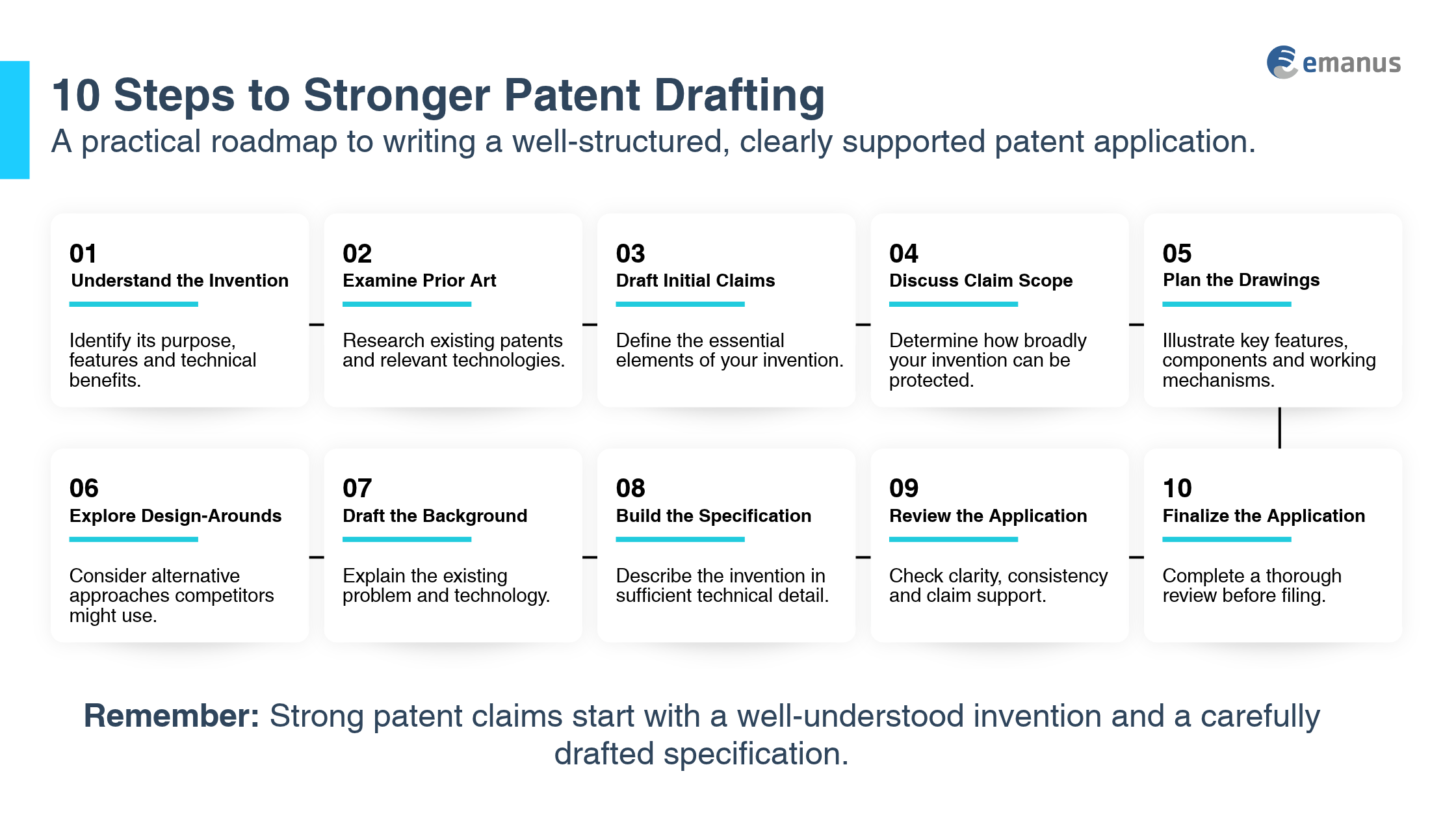
Here are 10 practical steps to help you approach patent writing with stronger, better-supported claims.
At a Glance: Your 10-Step Patent Drafting Roadmap
| 1. Understand the invention |
| 2. Examine prior art |
| 3. Draft initial claims |
| 4. Discuss claim scope |
| 5. Plan the drawings |
| 6. Explore design-arounds |
| 7. Draft the background |
| 8. Build the specification |
| 9. Review the application |
| 10. Finalize the application |
1. What Exactly Are You Trying to Protect?
Before drafting claims, get beyond the inventor’s pitch. You need to understand the actual technical solution.
Start by asking:
- What problem does the invention solve?
- What is the simplest version that actually works?
- Which components or steps make it work?
- How do those components interact?
- Which features are essential, and which are optional?
- What alternatives could achieve the same result?
Let’s use an example. Imagine you’ve developed a portable water filtration device. You might initially focus on its compact size, but the real technical difference could be the arrangement of its filtration layers or the way water passes through them.
Try this: Ask the inventor to explain the invention step by step, as if they were showing someone how to build it. If important parts of the explanation are still vague, clarify them before drafting.
2. Have You Checked What Already Exists?
You cannot decide how broadly to claim an invention without understanding what has already been disclosed.
This is where a prior-art search becomes essential. Search existing patents, published applications, technical publications, and other relevant disclosures to identify inventions that may overlap with yours.
A useful comparison looks like this:
| What to compare | Questions to investigate |
| Existing technology | What do similar products or patents already disclose? |
| Your invention | Which features are different? |
| Technical improvement | What does your particular arrangement or method achieve? |
| Potential claim scope | Which differences could form the basis of your claims? |
You can start exploring this process with the USPTO Patent Public Search tool, and our guide on how to conduct a comprehensive patent search explains how to approach the research.
3. How Do You Turn Those Differences Into Patent Claims?
Now you can start building the claim set.
Think of claims as the boundaries of the protection you’re asking for. They define the subject matter you want the patent to cover, so every word and limitation matters.
For a U.S. utility patent application, you’ll generally work with two main types of claims:
Independent claims define the invention without referring to another claim. They establish the main scope of protection being sought.
Dependent claims refer back to an earlier claim and add further limitations. They can cover particular materials, arrangements, components, or methods.
Using our filtration device example, the claim structure might look something like this:
| Claim | What it could cover |
| Independent claim | A portable filtration device comprising a housing, an inlet, a filtration assembly, and an outlet arranged in a particular configuration. |
| Dependent claim 1 | The filtration assembly comprises multiple filtration layers. |
| Dependent claim 2 | The filtration layers comprise specified materials. |
| Dependent claim 3 | The device includes a replaceable filtration cartridge. |
These are simplified illustrations, not claims ready for filing. The actual language needs to reflect the invention’s technical details and the results of the prior-art analysis. A useful approach to drafting patent applications is to consider the independent claim first, then identify additional features that could be included in dependent claims
4. Have You Agreed on the Claim Strategy With the Inventor?
This is a conversation worth having before the specification is fully drafted.
Share the initial claims and discuss:
- Why each feature is included.
- Whether the claim is unnecessarily restricted.
- Which features could be claimed separately or as dependent limitations.
- Whether alternative configurations are technically possible.
- Which features matter most to the product’s commercial value.
For example, the inventor may insist that the filtration device must use a particular filter material. But after discussing the technology, you might discover that the device can also work with alternative materials.
That could be important when deciding what to disclose and how to structure the claims.
5. What Drawings Will You Need to Support the Invention?
Once you have an initial claim strategy, plan the drawings around the features you intend to describe and claim.
A drawing should help someone understand the invention, not simply make the application look complete.
Depending on the technology, you may need:
- Overall views: Show the complete invention and its main components.
- Exploded views: Separate components to show how they fit together.
- Cross-sectional views: Reveal internal structures and arrangements.
- Flow diagrams: Explain how a method or process operates.
- Alternative views: Illustrate different configurations or embodiments.
The USPTO explains drawing requirements in its MPEP Chapter 600: Parts, Form, and Content of Application.
6. Could a Competitor Work Around Your Claims?
Here’s a question that can reveal weaknesses in a claim strategy: If someone wanted to make a similar product without using the exact features in your claims, what could they change?
This is often called considering potential design-arounds.
Discuss realistic alternatives with the inventor. Not every alternative needs to become a claim. But relevant variations should be considered before filing, because adding new technical subject matter later may not be permitted.
7. How Do You Write a Background That Doesn’t Restrict Your Invention?
The background section explains the technical field and the problem your invention addresses. It should give the reader context without unnecessarily narrowing the invention.
Keep it focused on three things:
- Introduce the relevant technical field.
- Explain the problem or limitations in existing approaches.
- Establish why a different technical solution may be useful.
8. Does Your Specification Actually Support Every Claim?
This is one of the most important checks in the entire process.
A claim needs adequate support in the specification. Under 35 U.S.C. § 112(a), a U.S. patent application must satisfy written description and enablement requirements, among others.
In straightforward terms:
Written description: Does the patent draft show that the inventor possessed the claimed invention at the time of filing?
Enablement: Does the application explain the invention sufficiently for a person skilled in the relevant field to make and use it without undue experimentation?
The USPTO provides detailed guidance on these requirements:
- 35 U.S.C. § 112: Specification and Claims
- MPEP § 2163: Written Description Requirement
- MPEP § 2164: Enablement Requirement
- MPEP § 608: Disclosure Requirements
Try this: Go through your claims one limitation at a time. Find where each feature is described in the specification. If you cannot point to adequate support, revisit the disclosure before filing.
9. What Should You Check Before Sending the Application for Approval?
Check whether the different parts actually agree with one another.
Use this review checklist:
| Review area | What to check |
| Claim scope | Do the claims reflect the intended protection strategy? |
| Technical support | Is every limitation adequately described? |
| Claim clarity | Are the terms and relationships clear? |
| Drawings | Do the figures match the written description? |
| Reference numbers | Are components identified consistently? |
| Alternative embodiments | Are relevant variations adequately disclosed? |
| Terminology | Are the same components described using consistent terms? |
| Inventor approval | Have technical questions and corrections been addressed? |
Under 35 U.S.C. § 112(b), claims must particularly point out and distinctly claim the subject matter regarded as the invention. The USPTO discusses this in MPEP § 2173: Definiteness of Claims.
You should also review the USPTO’s common patent application problems before filing.
10. When Should You Write the Summary and Abstract?
Leave these sections until the claims and detailed description are close to final.
Why? Because the summary and abstract should reflect what the application actually describes and claims, not an earlier version of the invention.
Once the claims are settled:
- Write the summary to present the invention’s main features.
- Prepare the abstract as a concise technical overview.
- Confirm that the drawings and figure descriptions are complete.
- Check that the terminology is consistent throughout.
- Send the complete application for final inventor approval.
What If You’re Filing a Provisional Patent Application?
A provisional application does not require formal claims. However, that doesn’t mean you can submit a brief description and leave the important technical details for later.
The disclosure must still satisfy the written description and enablement requirements of 35 U.S.C. § 112(a). For a more detailed explanation of the required sections and patent application format, consult the USPTO’s Provisional Application Filing Guide. You can also explore our guide to provisional vs. nonprovisional patent applications.
What Are the Most Common Mistakes That Weaken Patent Claims?
Even a well-organised drafting process can go wrong if you overlook the details. Watch out for these common problems:
| Mistake | A better approach |
| Starting with the product description instead of the inventive features | Identify the technical contribution first. |
| Skipping prior-art research | Search and compare relevant prior art before settling the claims. |
| Making the independent claim unnecessarily narrow | Consider broader scope where the prior art and disclosure support it. |
| Making claims broader than the disclosure supports | Describe the full scope you intend to claim. |
Frequently Asked Questions (FAQs)
How much does it cost to do a patent application?
The cost depends on the type of application, USPTO filing fees, and whether you hire a patent attorney or agent. Additional costs may include patent searches, drawings, and prosecution. Check the USPTO fee schedule for current official fees.
What are the 5 requirements for a patent?
In the United States, an invention generally needs to meet five key requirements: patentable subject matter, utility, novelty, non-obviousness, and adequate disclosure. The application must also meet requirements for written description, enablement, and definiteness.
What is the format for writing a patent application?
A typical U.S. utility patent application includes a title, cross-reference to related applications (if applicable), background, summary, brief description of the drawings, detailed description, claims, abstract, and drawings where required. The exact contents depend on the application. See the USPTO’s application guidance.
Can I patent an idea without a lawyer?
Yes. You can file your own patent application with the USPTO. However, an idea alone is not enough: you need to describe a specific invention that meets patentability requirements. A registered patent attorney or agent can help with claim drafting and application preparation.
Summing Up
Don’t leave your claims until the end. Build your application around them from the start, making sure every important claim is supported by your description and drawings.
A strong patent application does more than get filed. It gives your invention a meaningful foundation for protection.
Every invention has its own patent considerations. If you’d like a second perspective on yours, the Emanus team is happy to talk it through.