
Trademark infringement happens when a business uses a name, logo or slogan that is confusingly similar to another’s protected mark. Below are real trademark infringement examples, with year, court and outcome, plus logo infringement cases and the steps startups can take to avoid them.
Starting a business is exciting. You have the idea, the logo, maybe even the tagline. But there is a hidden risk many founders overlook: trademark infringement. A wrong step in branding could lead to legal trouble with companies that already own rights to certain names, designs or symbols.
What Is Trademark Infringement?
Trademark infringement happens when someone uses a protected mark in a way that is likely to confuse consumers about a product’s source. Courts decide infringement by examining the evidence. The United States Patent and Trademark Office (USPTO) handles federal trademark registration, not infringement rulings.
Courts may compare the marks’ appearance, sound and meaning. They also consider the relationship between the products, marketing channels and how customers make purchasing decisions.
The USPTO trademark infringement guidance explains the issue. A registration search is a useful first step, but it cannot guarantee that a proposed brand is safe to use.
Trademark Infringement Example: A Startup Coffee Brand
Hypothetical example, not a real case.
Imagine launching a coffee brand called “Starbrew” with a green circular logo. An established coffee business already uses a similar name and logo. Customers might assume the brands are connected.
The established business could challenge the branding and seek legal remedies. You might need to change your name, logo, packaging and website after investing in them. A search before launch could help you identify this risk earlier.
Trademark Infringement Cases at a Glance
These trademark infringement cases show how courts and businesses handle disputes involving names, logos, packaging and product identity. Outcomes vary by jurisdiction and evidence. A result in one case does not guarantee the same result for another business.
| Case | Year | Court or forum | Outcome |
| Apple Corps vs. Apple Computer | 2007 settlement | UK litigation; settlement between parties | Settled |
| Adidas vs. Thom Browne | 2023, appeal in 2024 | U.S. District Court, Southern District of New York; Second Circuit | Won by Thom Browne at trial and appeal; later review sought |
| Jack Daniel’s vs. VIP Products | 2023, further ruling in 2026 | U.S. Supreme Court; Ninth Circuit | Ongoing legal history, with mixed rulings |
| Nestlé vs. Cadbury | 2013 | England and Wales Court of Appeal | Won by Nestlé on appeal |
| Penn State vs. Vintage Brand | 2024 | U.S. District Court, Middle District of Pennsylvania | Won by Penn State at trial |
| Adidas vs. Steve Madden | 2025 | U.S. District Court, Eastern District of New York | Ongoing, stayed pending arbitration |
6 Famous Trademark Infringement Cases
These six trademark infringement cases offer practical lessons for startups. Each involves different facts, legal standards and outcomes. The cases are not all U.S. decisions, so jurisdiction matters when applying their lessons to your own brand.
1. Apple Corps vs. Apple Computer
Year: 2007 settlement. Court: UK litigation, including the High Court of Justice. Outcome: Settled.
The Beatles’ company, Apple Corps, and Apple Computer disputed their overlapping “Apple” names and logos. Earlier agreements divided their permitted uses. In 2007, the companies reached a new settlement covering trademark ownership and licensing. The settlement terms were confidential. Startup lesson: Define brand rights and permitted uses clearly when businesses operate in related markets.
2. Adidas vs. Thom Browne
Year: 2023, with an appeal in 2024. Court: U.S. District Court for the Southern District of New York and U.S. Court of Appeals for the Second Circuit. Outcome: Won by Thom Browne at trial and appeal; later review sought.
Adidas argued that Thom Browne’s stripe designs infringed its three-stripe trademark. A jury found Thom Browne not liable in 2023, and the Second Circuit affirmed in 2024. Adidas later sought further review in 2026. Startup lesson: Courts assess the overall impression and evidence of likely confusion, not just a shared design feature.
3. Jack Daniel’s vs. VIP Products
Year: Supreme Court decision in 2023; Ninth Circuit ruling in 2026. Court: U.S. Supreme Court and U.S. Court of Appeals for the Ninth Circuit. Outcome: Ongoing legal history, with mixed rulings.
VIP Products sold a parody dog toy resembling a Jack Daniel’s bottle. In 2023, the Supreme Court held that ordinary trademark analysis applies when a defendant uses a mark as a source identifier. In August 2026, the Ninth Circuit vacated an injunction on the dilution claim and remanded for judgment for VIP on that claim. Startup lesson: A parody label does not automatically avoid trademark scrutiny.
4. Nestlé vs. Cadbury: The Purple Trademark
Year: 2013. Court: England and Wales Court of Appeal. Outcome: Won by Nestlé on appeal.
Cadbury sought trademark protection for a specific purple shade used on chocolate packaging. Nestlé challenged the application. The Court of Appeal rejected the proposed registration because the description did not define the mark with sufficient clarity. Startup lesson: A colour can identify a brand in some circumstances, but the mark must be defined precisely and meet legal requirements.
5. Penn State vs. Vintage Brand
Year: 2024. Court: U.S. District Court for the Middle District of Pennsylvania. Outcome: Won by Penn State at trial.
Penn State challenged Vintage Brand and Sportswear over merchandise featuring the university’s vintage logos and images. A federal jury awarded Penn State $28,000 in damages. The defendants had argued that their website made clear they were not affiliated with the university. Startup lesson: A disclaimer may not resolve every problem created by unauthorized use of another brand’s marks.
6. Adidas vs. Steve Madden
Year: 2025. Court: U.S. District Court for the Eastern District of New York. Outcome: Ongoing, stayed pending arbitration.
Steve Madden sued Adidas over challenges to footwear designs featuring two bands. The court stayed the proceedings while an arbitrator considered whether the dispute was subject to arbitration. The case was administratively closed in July 2025, which does not mean the underlying dispute was finally decided on its merits. Startup lesson: Check the procedural status before describing a dispute as won or lost.
Logo Infringement Cases: Real Examples Startups Can Learn From
Logo infringement cases arise when a logo’s overall appearance could confuse customers about a product’s source. Courts may consider shapes, colours, lettering, symbols and how a design appears on related products. A single shared colour or shape does not automatically establish infringement.
Three examples show why the full context matters:
- Adidas vs. Thom Browne: The dispute focused on stripe designs on clothing and footwear. The U.S. jury found Thom Browne not liable, and the Second Circuit affirmed in 2024. The later petition for review should be checked for current status.
- Penn State vs. Vintage Brand: The dispute concerned the use of university logos and images on merchandise. A jury found Penn State in 2024. The case highlights the risks of using a brand’s logo without permission.
- Jack Daniel’s vs. VIP Products: The “Bad Spaniels” toy copied elements of the whiskey bottle’s look and labeling for parody. The Supreme Court explained that trademark rules can still apply when a mark is used to identify the defendant’s own product.
Logo Infringement Examples Startups Overlook
Common logo risks include:
- Using similar colours and shapes in a related industry.
- Choosing a font or lettering style that resembles a competitor’s logo.
- Reusing a distinctive symbol associated with another brand.
- Copying the overall look of a logo, rather than one isolated design element.
The key question is whether the branding could confuse customers in context.
Logo Copyright vs. Trademark Infringement: Which Right Protects Your Branding?
Trademark law protects brand identifiers, such as names, logos used to identify a source, taglines and certain packaging designs. Copyright protects original creative expression, including eligible logo artwork, illustrations, photographs and website text. A logo may qualify for both forms of protection, and one use can raise both trademark and copyright concerns.
| Branding asset | Main protection | Example of a possible violation |
| Business name | Trademark | Using a confusingly similar name in a related market |
| Logo | Trademark and potentially copyright | Using a confusingly similar logo or copying original artwork |
| Tagline or slogan | Trademark, where eligible | Using a similar slogan that confuses customers |
| Packaging or bottle shape | Trademark or trade dress, where eligible | Copying distinctive packaging that signals a brand |
| Brand photos, illustrations and website copy | Copyright, where eligible | Reusing protected creative work without permission |
For example, creating a logo that closely resembles a competitor’s logo may raise trademark concerns. Copying the competitor’s original artwork file may also raise copyright concerns. The legal analysis depends on the facts and the rights involved.
For a broader comparison, read our copyright vs trademark vs patent guide.
What Does Trademark Litigation Cost?
Trademark litigation can cost hundreds of thousands of dollars, depending on the dispute, discovery, expert evidence and whether the case reaches trial. A U.S. government working paper citing the American Intellectual Property Law Association’s 2023 Economic Survey reports estimates of $375,000 to $500,000 through the end of discovery, and $750,000 to $1.5 million or more through trial. These are broad estimates, not a quote for every case.
Startups can reduce avoidable risks by searching before launch, documenting their branding decisions and getting advice when a conflict appears.
Useful resources include:
- USPTO, for U.S. trademark registration information.
- World Intellectual Property Organization (WIPO), for international intellectual property enforcement resources.
- PACER, for U.S. federal court records.
Key Trademark Terms Every Founder Should Know
- Cybersquatting: Registering or using a domain name in bad faith to profit from another party’s trademark.
- Trade dress infringement: Using a product’s distinctive packaging or overall appearance in a way that may confuse consumers.
- Brand dilution: Unauthorised use that weakens the distinctiveness of a famous mark or harms its reputation, even without ordinary confusion.
- Genericide: When a brand name becomes the common name for a type of product and loses its trademark significance. This is different from dilution.
- IP litigation costs: Legal fees and related expenses involved in resolving intellectual property disputes.
- Parody defense in trademark law: A parody may be relevant to the legal analysis, but it does not automatically protect a product that uses a mark as a source identifier.
Common Trademark Infringement Examples Startups Overlook
- Similar sounding names: Two names can sound alike even when their spelling differs.
- Look-alike logos: Colours, fonts or designs can create confusion when the overall appearance is similar.
- Copying product packaging: Similar labels or distinctive packaging may cause customers to assume a connection.
- Domain name misuse: Registering domains that imitate another brand can raise trademark or cybersquatting concerns.
These risks may seem minor at launch, but they can affect your reputation, budget and ability to keep using your brand.
How Startups Can Avoid Trademark Infringement
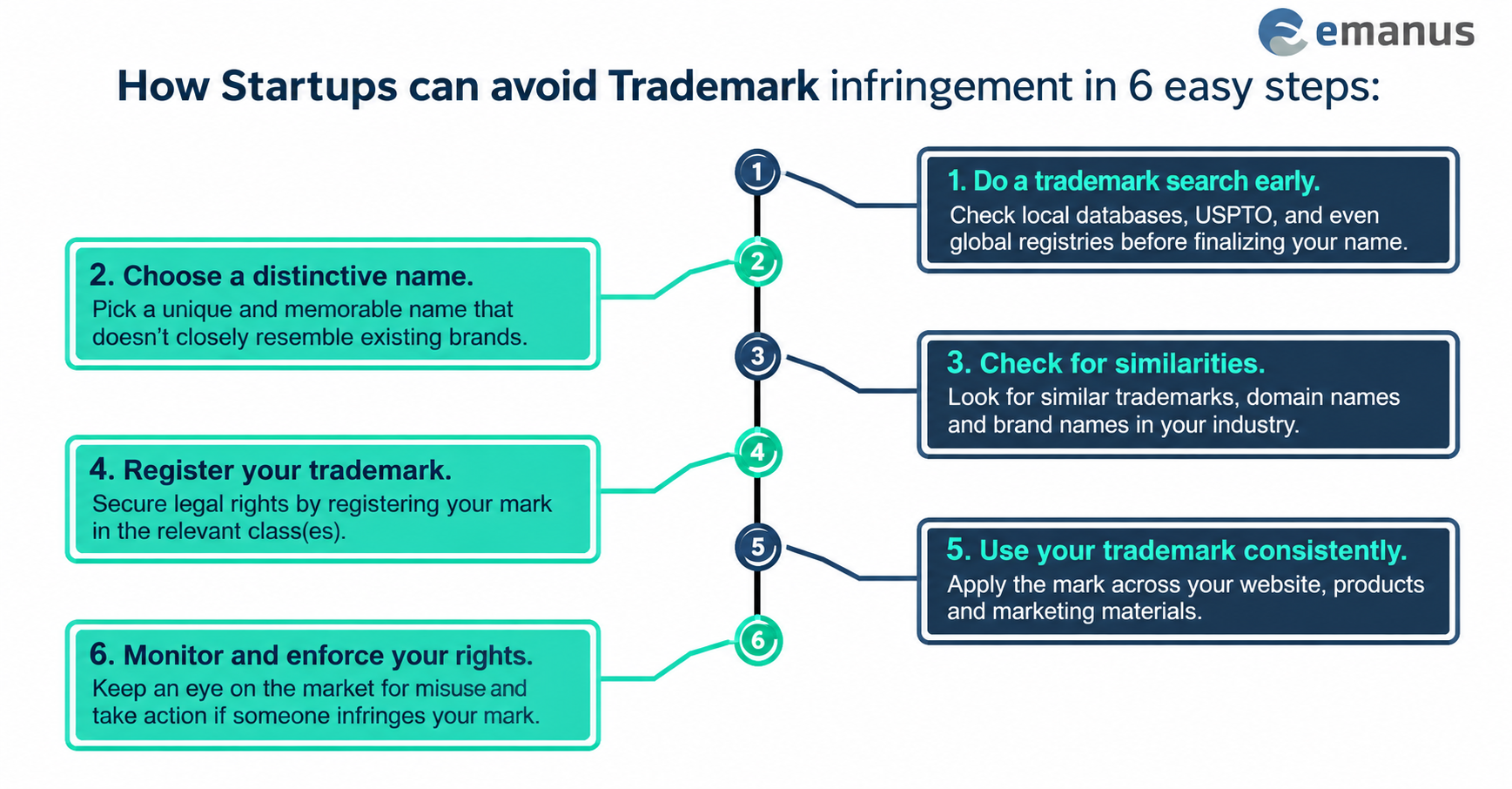
Startups can lower trademark risk by choosing distinctive branding, searching existing marks, documenting ownership and monitoring the market. These six steps help you identify problems earlier. They do not guarantee that a brand is legally clear, but they provide a practical starting point.
- Search before choosing a name. Review the USPTO database and relevant business, domain and marketplace results.
- Choose distinctive branding. Avoid names and logos that closely resemble competitors in related markets.
- Protect your brand assets. Consider appropriate registration for names, logos and slogans. Assess whether other rights may apply.
- Monitor the market. Watch for confusingly similar names, logos and domain registrations. See our trademark monitoring guide.
- Be careful with parody or homage. Changing a name slightly or calling a design a parody does not automatically prevent a claim.
- Plan for disputes. Keep records of design creation, searches, permissions and registration documents. Budget for legal advice when a conflict arises.
What to Do if You’re Accused of Infringement
If you receive a legal notice, do not ignore it. A cease and desist letter is a formal warning, not a court order, but it should be taken seriously. The response may affect your options.
- Stay calm and get legal advice. Keep the letter, note any deadlines and avoid making rushed admissions.
- Evaluate your brand. Review the marks, products, markets and evidence cited in the complaint.
- Consider your options. Depending on the facts, you may negotiate, defend your use or rebrand.
Lessons for Startups from Trademark Disputes
- Prevention is cheaper than litigation. Searching and planning early may help avoid expensive disputes.
- Don’t underestimate established brands. A smaller business can face a challenge if its branding creates a legal conflict.
- Protect your identity too. As your startup grows, consider how to protect your own name, logo and other brand assets.
For a startup-focused roadmap, read our trademark tips for startups.
Frequently Asked Questions (FAQs)
How do you avoid trademark infringement?
Search existing marks before choosing a name or logo, select distinctive branding, and consider registration. Monitor competitors and marketplaces. For a higher-risk brand or a possible conflict, seek advice from a qualified trademark professional before investing further.
Which big companies have sued for intellectual property infringement?
Companies including Apple, Adidas, Louis Vuitton and Jack Daniel’s have brought intellectual property disputes. The claims and outcomes differ, so a lawsuit alone does not establish that the defendant infringed a trademark.
What is trademark infringement?
Trademark infringement is unauthorized use of a protected mark in a way that is likely to confuse consumers about a product’s source. Courts assess the facts, including the marks, goods and purchasing context.
What are three examples of intellectual property violations?
Examples include trademark infringement involving a confusingly similar brand name, copyright infringement involving copied artwork, and patent infringement involving an invention covered by a valid patent.
What are two examples of a trademark?
The Nike swoosh and Coca-Cola’s script logo are examples of brand identifiers. Trademark protection depends on the applicable rights, use and legal requirements.
What are the four common types of trademarks?
Common categories include word marks, design marks such as logos, slogans, and trade dress such as distinctive product packaging. The availability and scope of protection depend on the specific mark and applicable law.
How do you win a trademark infringement lawsuit?
A plaintiff generally must establish enforceable trademark rights and show a likelihood of consumer confusion, along with any other elements required for the claim. Registering first does not automatically win a case. Outcomes depend on the evidence and applicable law.
What is the difference between trademark infringement and dilution?
Trademark infringement generally focuses on likely consumer confusion. Trademark dilution concerns certain uses that weaken the distinctiveness of, or harm the reputation of, a famous mark. Dilution has separate legal requirements and does not apply to every well-known brand.
Can a logo be both trademarked and copyrighted?
Yes. A logo may qualify for trademark protection when it identifies a source and copyright protection when it contains sufficiently original creative expression. The two rights protect different interests, and eligibility depends on the logo and circumstances.
What should you do if you receive a cease and desist letter?
Preserve the letter and relevant records, note any stated deadlines, and seek qualified legal advice. Do not assume the letter proves infringement, but do not ignore it. A professional can help assess the claims and possible responses.
Conclusion
Trademark disputes aren’t just for Fortune 500 giants. They can derail startups too. By studying trademark infringement examples and learning from high-profile trademark cases, founders can protect their businesses from costly mistakes.
Trademark law is strategic. Each case shows the importance of originality, vigilance and informed decisions.
If you are building a brand and want to understand your options, talk to an IP attorney at Emanus about a trademark roadmap for your startup.