
If you’ve heard that “software can’t be patented,” you’ve only heard half the story.
Every year, thousands of software patent applications are filed with the expectation of protecting innovative technology. Many are rejected, not because the invention lacks value, but because it’s claimed in a way that U.S. patent law does not allow.
The question “Is software patentable?” has a more complex answer. Software itself isn’t patentable, but software-based inventions absolutely can be. The difference lies in how the invention is drafted.
In this guide, we’ll explain why software patent applications are rejected, what current examination trends reveal, and the strategies that give software-related inventions the strongest chance of being patented in 2026.
Is Software Patentable?
Software-related inventions are patentable in the United States, but software code itself, claimed in the abstract, is not. The distinction matters because it determines whether your application is examined as a legitimate computer-implemented invention or rejected outright as an unpatentable abstract idea under 35 U.S.C. § 101.
The honest answer to “is software patentable” is “no, but also yes.” A patent claim that simply recites “software that performs functions X, Y, Z” is not allowed under current U.S. patent law. But a patent claim describing a computer configured to perform those functions, a computer-implemented method comprising those steps, or a non-transitory computer-readable medium that configures a computer to perform them, is patentable and granted.
This is not a technicality lawyers invented to bill more hours. It reflects a genuine legal boundary: patents protect functional, technical inventions, not abstract ideas, mathematical formulas, or business methods recited generically on a computer.
What Is a Software Patent?
Patenting software is a term for a patent that protects an invention whose novelty and functionality are implemented through computer code, not a patent that claims source code directly. No issued U.S. patent claims literal lines of software code; every valid software patent application instead claims the system, method or technical process the code carries out.
In practice, the relationship between a patent and software is about protecting innovation in computer technology, not ownership of the code that developers write.
Why Is Software Not Patentable? The Real Answer
Software is excluded from direct patent protection because the Supreme Court’s 2014 Alice Corp. v. CLS Bank International decision established that abstract ideas including software described only in functional, results-oriented terms are not patent-eligible subject matter. The target is abstraction, not software as a category.
Following the decision, Section 101 rejections in software-affected technology areas increased by 31% within 18 months, according to a USPTO economic research report. Patent eligibility uncertainty in the same period rose by 26%, reflecting wide inconsistency between examiners applying the new standard.
Where Section 101 rejections concentrate most heavily:
| Technology Center | Subject Matter | Section 101 Rejection Severity |
| TC 3600 / 3700 | Business methods, business-implemented software | Highest — affirmance rates above 95% |
| TC 2100 | Core computing technologies | High — affirmance rates above 85% |
| Hardware-integrated software (IoT, embedded systems) | Software tied to physical components | Moderate — fewer abstract idea rejections |
| AI and machine learning applications | Algorithm-driven inventions | Rising — increasingly scrutinized under “mental processes” category |
How to Draft a Software Patent Application That Survives Examination
Successful legal patent software strategies focus on demonstrating a technical improvement that satisfies patent eligibility requirements instead of simply describing what the software accomplishes.
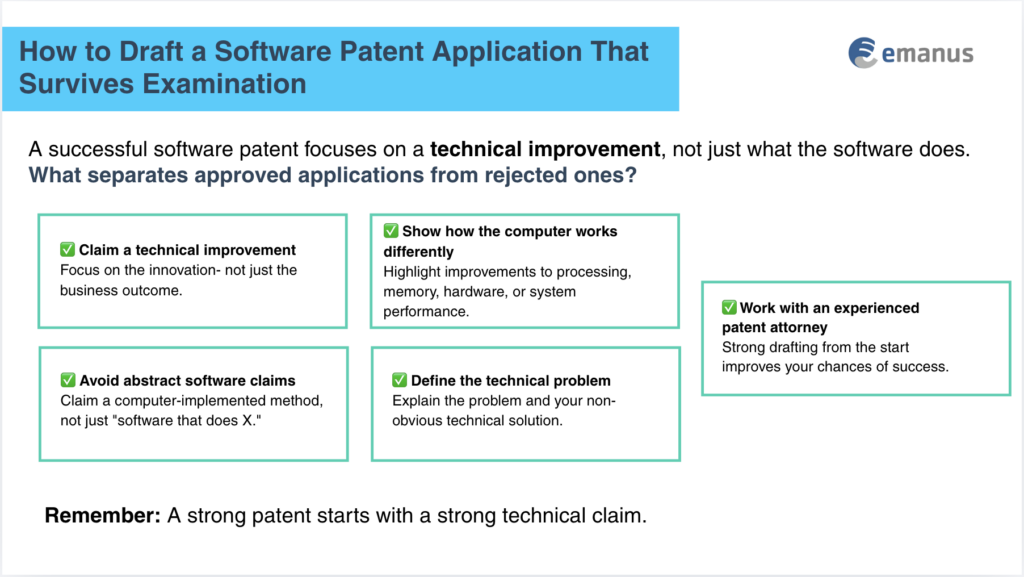
What separates surviving applications from rejected ones:
- Claim a specific technical improvement, not a business outcome. “A method for reducing database query latency by restructuring index allocation” survives scrutiny far better than “a method for processing customer data more efficiently.”
- Tie the invention to how a computer operates, not just what it accomplishes. Claims describing changes to processing architecture, memory allocation, network routing, or hardware interaction are evaluated more favorably than claims describing a desired business result.
- Avoid claiming the software in the abstract. Per the core distinction in current U.S. patent law, claim a computer configured to perform specific steps, a computer-implemented method comprising those steps, or a computer-readable medium configuring those steps — never “software that does X.”
- Document the technical problem being solved, not just the solution. Applications that establish a concrete technical problem (e.g., a specific inefficiency in existing systems) and a non-obvious technical solution fare significantly better under Step 2A/2B of the Alice analysis.
- Work with a patent attorney experienced in drafting strategy from the outset.
Patent Drawing Software for Legal Filings
USPTO patent applications require formal drawings that meet specific formatting standards under 37 CFR 1.84 and most patent attorneys use professional CAD or technical illustration tools such as SolidWorks, AutoCAD or specialized patent drafting software like PatentDraw or PatSnap’s drawing tools, to ensure compliance with USPTO requirements.
For software inventions specifically, patent drawings typically take the form of flowcharts, system architecture diagrams and user interface mockups rather than mechanical schematics.
While some inventors search for patent filing software, no software can replace the legal drafting required for strong patent claims.
Conclusion
Software patents are neither impossible nor automatic. The success of a software patent application depends on how that idea is translated into legally defensible patent claims.
At Emanus LLC, we help software startups, AI companies, SaaS founders and technology innovators move beyond filing patents to building intellectual property that creates real business value. If you’re developing a software-based invention and want to know whether it’s patentable, contact Emanus LLC for a patent strategy consultation. We’ll help you assess your invention and build an IP strategy designed to support your business as it grows.
Software Patentable Frequently Asked Questions
- What software is patentable?
Yes, software is patentable when claimed to perform specific technical functions. It’s not when claimed as software in the abstract. Inventions tied to a specific technical improvement, such as processing efficiency or system architecture changes, are most likely to survive examination.
- What is meant by a software patent?
A software patent is a patent protecting an invention implemented through computer code, claimed through its technical system, method, or process. Source code is separately and automatically protected by copyright.
- Why is software not patentable?
Software claimed purely as an abstract idea or a desired result is excluded from patent protection under the Supreme Court’s Alice Corp. v. CLS Bank decision, which held that abstract ideas implemented on a generic computer don’t qualify as patent-eligible subject matter. Software tied to a specific technical improvement remains patentable.
- What are the 4 types of patents?
The U.S. recognizes three patent types: utility, design and plant patents. Software-related inventions are pursued as utility patents.
- Can you patent software?
Not directly as software code, but yes as a computer-implemented method, system, or computer-readable medium that performs specific technical functions. The application’s success depends heavily on how the claims are drafted around the underlying technical mechanism. - What’s the best patent drawing software for legal filings?
Most patent attorneys use professional CAD tools like SolidWorks or AutoCAD, or specialized patent drafting software, to meet USPTO formal drawing requirements.