
You finally filed your trademark application. Then an email from the USPTO arrives with the words “Office Action.”
For many innovators and business owners, it feels like a rejection.
Fortunately, that’s usually not the case.
A Trademark Office Action is simply the USPTO asking you to resolve specific issues before your trademark can move forward. Many applications receive one, and a well-prepared trademark office action response often leads to successful registration.
In this guide, we’ll explain what a Trademark Office Action is, why it happens, how to respond, and when hiring a trademark office action lawyer can significantly improve your chances of success.
What Is a Trademark Office Action?
A Trademark Office Action is an official letter issued by the USPTO examining attorney after reviewing your trademark application.
Rather than automatically rejecting your application, the examiner identifies issues that must be corrected, clarified, or legally addressed before registration can continue.
Most applicants receive one of two types:
-
Non-Final Office Action
This is the most common type.
The examiner has identified concerns but gives you an opportunity to fix them by amending your application, providing additional evidence and making legal arguments supporting registration.
Common issues include:
- Likelihood of confusion
- Descriptiveness
- Improper specimens
- Identification of goods or services
- Technical filing errors
2. Final Office Action
If your first response does not resolve the examiner’s concerns, the USPTO may issue a Final Office Action.
At this stage, your options become more limited and may include:
- Filing stronger legal arguments
- Requesting reconsideration
- Appealing to the Trademark Trial and Appeal Board (TTAB)
A Final Office Action is more serious, but it still does not automatically end your trademark application.
Why Did You Receive a Trademark Office Action?
Several issues commonly trigger a USPTO refusal.
1. Likelihood of Confusion (Section 2(d))
This is one of the most common reasons for refusal.
If your trademark is too similar to an existing registered mark for related goods or services, consumers could confuse the two brands.
Example
Suppose you apply to register Star Brew for coffee products.
The USPTO may refuse registration because consumers could associate it with the well-known Starbucks brand.
2. Your Trademark Is Descriptive (Section 2(e))
Descriptive trademarks simply describe the product rather than identify its source.
Example
Trying to register Creamy Coffee for coffee products.
The examiner may argue that consumers immediately understand what the product is rather than recognizing it as a brand.
3. Improper Trademark Specimens
The USPTO requires proof that you’re actually using your trademark in commerce.
Acceptable specimens include:
For goods:
- Product packaging
- Labels
- Tags
For services:
- Website screenshots
- Advertising materials
- Service brochures
A mockup or digitally created image won’t satisfy USPTO requirements.
4. Incorrect Identification of Goods or Services
Descriptions that are too broad often generate office actions.
Example
Instead of clothing, use something more specific like T-shirts, hoodies, athletic jackets.
Clear descriptions reduce confusion and improve examination efficiency.
5. Technical Filing Problems
Sometimes the refusal has nothing to do with the trademark itself.
Examples include missing signatures, incorrect filing fees, incomplete application forms and classification errors.
These issues are usually straightforward but still require timely correction.
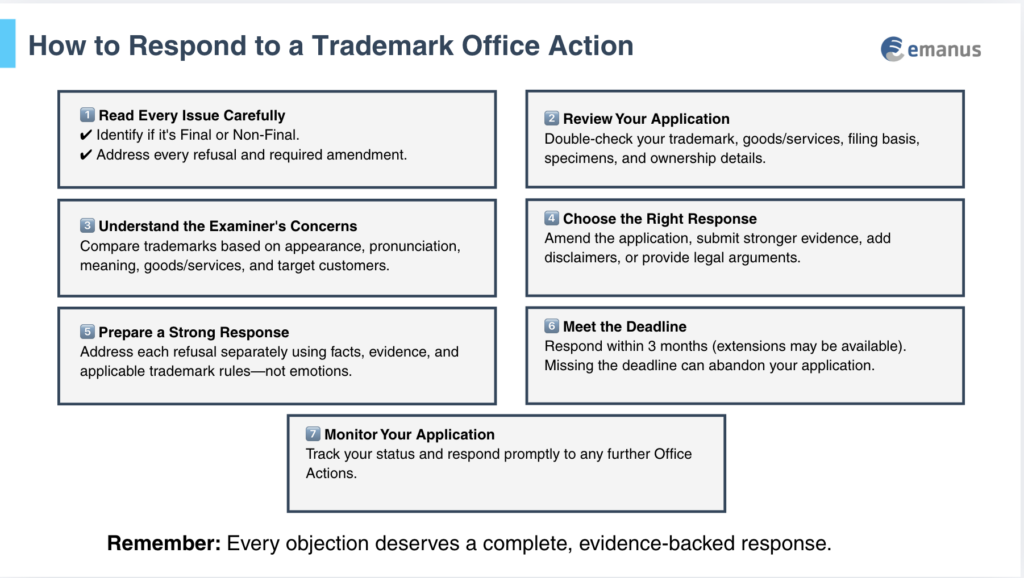
How to Respond to a Trademark Office Action
A successful office action response trademark submission requires more than simply disagreeing with the examiner.
Each objection should be addressed individually with evidence and legal reasoning where appropriate.
Step 1. Read Every Issue Carefully
Begin by identifying:
- Whether the Office Action is Final or Non-Final
- Every refusal
- Every required amendment
Do not assume only the first issue matters. Failing to respond to every objection may result in abandonment.
Step 2. Review Your Original Application
Double-check:
Trademark wording
Goods and services
Filing basis
Specimens
Ownership information
Many Office Actions stem from application errors that can be corrected.
Step 3. Research the Examiner’s Concerns
If the refusal cites another trademark, compare:
Overall appearance
Pronunciation
Meaning
Relatedness of goods
Target customers
Step 4. Choose the Right Response Strategy
Depending on the refusal, you may:
Amend your identification of goods.
Submit better specimens.
Add disclaimers.
Provide legal arguments.
Submit supporting evidence.
Request reconsideration.
Step 5. Prepare Your Trademark Office Action Response
Your response should address every refusal separately. Include supporting evidence. Cite applicable trademark rules when appropriate. Remain professional and fact-based
Avoid emotional arguments such as: “I worked very hard on this brand.”
The USPTO evaluates legal evidence, not personal investment.
Step 6. File Before the Deadline
Most USPTO Office Actions provide three months to respond. Applicants may request an extension of up to an additional three months by paying the required USPTO extension fee.
Missing the deadline results in abandonment of the application.
Step 7. Monitor Your Application
After filing your response, track your application through TSDR. Watch for additional correspondence. Respond promptly if another Office Action is issued.
Some applications require multiple rounds before approval.
Real Examples of Trademark Office Action Responses
| Office Action Issue | Possible Response |
| Likelihood of confusion | Demonstrate differences between the marks, goods, or consumers |
| Descriptiveness | Argue the mark is suggestive rather than descriptive or provide acquired distinctiveness evidence where applicable |
| Improper specimen | Submit a qualifying specimen showing actual use in commerce |
| Goods description | Amend the wording to use acceptable USPTO terminology |
| Missing information | Correct technical deficiencies and resubmit required documents |
Every Office Action is unique, so the response should be tailored to the specific objections raised.
Trademark Office Action Frequently Asked Questions
- What is a Trademark Office Action?
A Trademark Office Action is an official USPTO letter identifying issues with your trademark application that must be resolved before registration can proceed. It is not an automatic rejection.
- How do I respond to a trademark office action?
Review every issue raised by the examining attorney, gather any required evidence, prepare legal arguments or amendments as needed, and submit a complete trademark office action response through the USPTO before the deadline.
- How long does it take to respond to a trademark office action?
The preparation time depends on the complexity of the issues. Some technical corrections can be completed quickly, while legal refusals involving likelihood of confusion or descriptiveness often require more detailed analysis.
- When you receive an Office Action, the latest you can respond is?
The standard deadline is three months from the issue date. Applicants may request an extension for up to an additional three months by paying the required USPTO extension fee. Missing the final deadline typically results in abandonment of the application.
Takeaway
Receiving a Trademark Office Action does not mean your application has failed. In many cases, it simply means the USPTO needs additional clarification, evidence or legal support before approving your trademark.
Don’t let an Office Action derail your trademark registration. Our qualified trademark office action lawyers can help you:
- Analyze USPTO refusals
- Develop persuasive legal arguments
- Prepare compliant evidence
- Respond to Final Office Actions
- Protect long-term brand rights
Contact Emanus today to discuss your case and build a response that gives your brand the strongest path toward registration.