
Every year, thousands of inventors come up with brilliant ideas.
Far fewer successfully turn those ideas into profitable products. Over 90% of patents filed never generate commercial value.
The difference is having the right process, the right strategy and the right guidance from the beginning.
At Emanus, we believe innovation deserves more than protection. It deserves a pathway to market success.
As a one-stop destination from ideation to commercialization, we help entrepreneurs, independent inventors, and small-to-medium-sized businesses transform promising concepts into market-ready products with confidence.
Here’s a look at the step-by-step intellectual property process we use to help clients move from idea to commercialization.
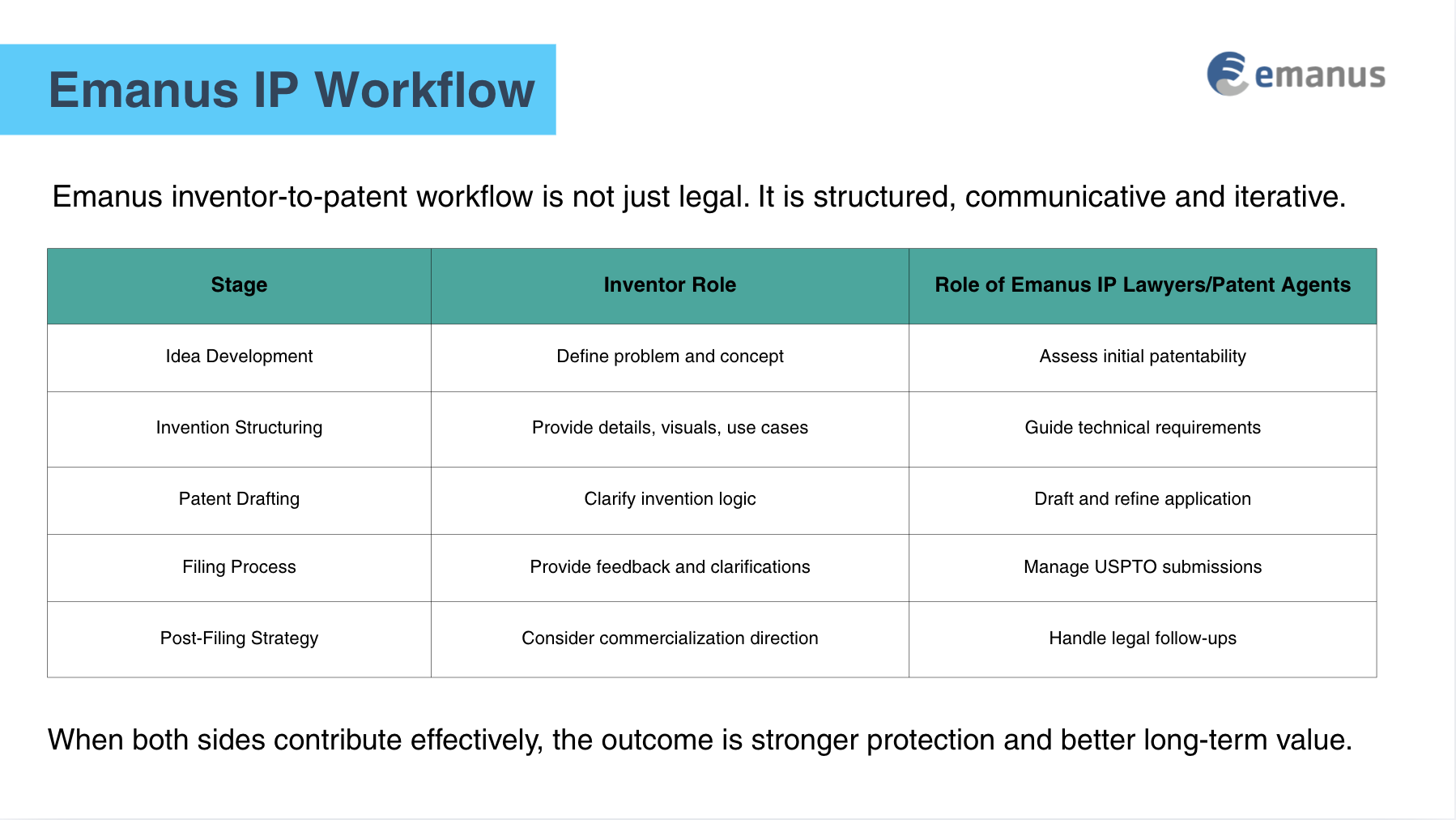
Why a Structured Commercialization Process Matters
In practice, inventors move too quickly into protection or development without testing whether the idea is fully defined or commercially aligned.
For example, it is common for inventors to invest heavily in patent filings before understanding whether their invention solves a validated market need. In other cases, they begin prototyping without a clear intellectual property strategy, which later limits their ability to protect or monetize the invention effectively.
Industry research in product development consistently shows that a significant portion of product failures stem from misalignment between invention, market demand and execution strategy, not from lack of innovation.
A structured commercialization process helps prevent this by introducing clarity at every stage of decision-making.
Step 1: Ideation and Concept Development
Every successful invention process begins with a problem worth solving.
The focus is refining ideas into something technically and commercially meaningful.
For example, one early-stage inventor approached with the idea of a “smart tracking device for healthcare.” While promising, it was too broad to support a strong intellectual property position.
Through structured refinement, the concept was narrowed into a specific application: remote monitoring for elderly patients with mobility risks in home-care environments.
Important questions at this stage:
- What problem does the invention solve?
- Who will benefit from the solution?
- What makes the concept different from existing alternatives?
Step 2: Market Validation
A technically impressive invention may still fail if the market doesn’t need it.
For example, a packaging innovation initially designed for retail consumer use was later validated through industry research to have stronger demand in industrial logistics, where cost reduction per shipment had a measurable financial impact.
Validation can be done through customer interviews, surveys, industry research and competitive analysis.
Step 3: Intellectual Property Protection
Without the right protection strategy, inventors risk losing ownership advantages and competitive positioning. For instance, two inventors may describe similar concepts, but the resulting patents can differ significantly in scope and strength based on how well novelty is articulated.
Potential protection options are:
- Patents
- Trademarks
- Design rights
- Copyrights
- Trade secrets
The appropriate strategy depends on the invention, whether you want to patent your idea and commercialization plans.
Step 4: Prototype Development
Once the invention is clearly defined and positioned, it moves into physical or functional validation.
Prototyping reveals insights that are not visible in early conceptual stages.
For example, an inventor working on a mechanical system discovered during prototyping that production costs were nearly double initial estimates due to material constraints. This insight led to a redesigned version that was both more manufacturable and more commercially viable.
In fact, most successful products undergo multiple refinements before reaching stability.
Step 5: Commercialization Strategy Development
This is where many inventors struggle.
A patent is not a commercialization plan. A prototype is not a business model.
Successful innovation requires a clear strategy for generating value from intellectual property.
For example, one inventor with a mechanical innovation originally planned direct manufacturing. However, early financial modeling showed high tooling costs and long breakeven timelines.
After commercialization analysis, the strategy shifted to licensing allowing the inventor to generate revenue through IP ownership rather than production.
Step 6: Manufacturing and Supplier Planning
An excellent product design still needs to be produced efficiently and cost-effectively.
This stage focuses on manufacturing readiness, supplier sourcing, production planning and cost optimization.
Step 7: Sales Strategy and Market Entry
A successful launch requires a clear path to customers.
The same product can be positioned as a consumer convenience tool or a B2B efficiency solution and those two paths lead to completely different revenue models and customer acquisition strategies.
Channel selection, messaging clarity and distribution strategy become critical components of the commercialization process.
Step 8: Growth, Licensing and Long-Term Value Creation
Commercialization does not end at launch.
Once a product enters the market, intellectual property becomes a strategic asset that can be expanded, licensed or leveraged for partnerships.
Successful inventions evolve into broader portfolios with new filings, geographic expansion or cross-industry licensing opportunities.
The Emanus Difference
Many firms specialize in one piece of the puzzle.
Some focus only on patents. Others focus only on product development.
While others focus only on business strategy.
Emanus operates at the intersection of all three.
Our 150+ clients have benefitted from::
Holistic Guidance
From idea generation through commercialization, every step is connected to a larger strategy.
Intellectual Property Expertise
Patents, trademarks, copyrights, designs and trade secrets are integrated into a broader commercialization framework.
Commercialization Focus
We help innovators create revenue opportunities, not just secure protection.
Cost-Effective Solutions
We help clients prioritize resources and avoid unnecessary spending.
Personalized Support
Every invention, inventor and commercialization journey is unique.
Proven Experience
With more than 25 years of experience and over 200 patents filed, we bring practical insight to every project.
FAQs
- What is product commercialization?
Product commercialization is the process of turning an idea or invention into a market-ready product that can generate revenue through sales, licensing, or other business models.
- When should I protect my intellectual property?
Intellectual property protection should be considered before publicly disclosing your invention or sharing it with potential partners, manufacturers, or investors.
- Do I need a patent before building a prototype?
Not always. The right timing depends on your invention, business goals, and commercialization strategy. An IP professional can help determine the best approach.
- How do I know if my invention has market potential?
Market validation, customer feedback, competitive analysis, and commercial assessments can help determine whether there is sufficient demand for your idea.
- How can Emanus help in patent filing and commercialization?
Emanus supports innovators through ideation, valuation, IP protection, prototype development, commercialization planning, licensing strategies, sales strategy and market entry.
- What is the biggest mistake inventors make during commercialization?
One of the most common mistakes is investing heavily in development before validating market demand or creating a clear commercialization strategy.
Final Thoughts
The journey from idea to invention to market can feel overwhelming.
There are countless decisions and risks.
But innovators don’t have to navigate the process alone.
At Emanus, we’ve built a proven framework that helps entrepreneurs, inventors, and growing businesses move confidently from concept to commercialization while protecting what makes their ideas valuable.
Whether you’re refining an early-stage concept, exploring patent protection, building a prototype or preparing for market launch, the right strategy can dramatically improve your chances of success.
Schedule a confidential consultation with Emanus today and discover how our proven intellectual property and commercialization process can help transform your innovation into a profitable business opportunity.