

Getting a patent is exciting. But here’s the reality many inventors discover too late:
A patent alone does not build a business.
Many startups, entrepreneurs and innovators spend thousands protecting their ideas, only to realize they still don’t know how to turn that intellectual property into revenue or market advantage.
That’s where the difference between a traditional Law Firm and an IP Commercialization firm becomes critical.
While both may help protect your invention, their goals are often very different. Understand that distinction to make smarter decisions from the very beginning.
What Traditional Law Firms Typically Focus On
A traditional patent law firm is often focused primarily on securing legal rights and managing filings correctly.
That typically includes:
- Patent drafting and prosecution
- Trademark filings
- IP agreements
- Legal compliance
- Managing deadlines and filings
Large law firms, often referred to as “BigLaw,” usually provide a wide range of legal services beyond patents, including litigation, licensing, copyrights and corporate law.
What an IP Commercialization Firm Brings to the Table
An IP commercialization-focused firm looks beyond simply filing patents.
This broader focus on invention commercialization helps innovators move toward long-term market value.
That may include helping innovators:
- Prioritize inventions with market potential
- Align IP strategy with funding goals
- Build stronger licensing opportunities
- Develop scalable patent portfolios
- Position innovation competitively in the market
- Manage IP budgets strategically during growth stages
Instead of treating patents as isolated legal documents, commercialization-focused firms treat IP as part of a larger business strategy.
Why Inventors Need More Than Just Patent Filing
A patent only becomes valuable when it supports:
- Business growth
- Investor confidence
- Licensing opportunities
- Product differentiation
- Competitive advantage
Without a patentcommercialization strategy linked to a broader business plan, even a strong patent may never generate meaningful business value.
That’s why many modern innovators are looking for partners who understand both intellectual property protection and commercialization strategy together.
Law vs IP Commercialization Support
One of the biggest differences inventors notice is the level of involvement and strategic guidance they receive.
At many large law firms:
- Senior partners may pitch the work
- Junior associates often handle execution
- Teams may rotate frequently
- Costs can increase due to large operational overhead
For massive corporations managing global patent portfolios, this structure may work well.
But startups and small businesses often need something different:
hands-on guidance, practical business insight and close collaboration.
IP commercialization-focused firms often provide:
- Direct access to senior professionals
- Personalized strategic guidance
- Specialized technical expertise
- Flexible pricing structures
- Long-term partnership support
- Faster communication and decision-making
Many also offer flat-fee models, helping startups better predict and manage IP costs during critical growth phases.
For founders balancing fundraising, product development and market entry, that predictability can be extremely valuable.
| Factor | Traditional Law Firm | IP Commercialization Firm |
| Primary Focus | Legal protection and filings | Turning IP into business value |
| Main Services | Patent drafting, trademarks, legal compliance | IP strategy, commercialization, portfolio planning |
| Attorney Involvement | Often delegated to junior associates | Senior experts stay directly involved |
| Cost Structure | Usually hourly billing | Often flexible or flat-fee models |
| Ideal For | Large enterprises with broad legal needs | Startups, inventors, SMBs, and growth-stage companies |
Why Commercialization Strategy Matters
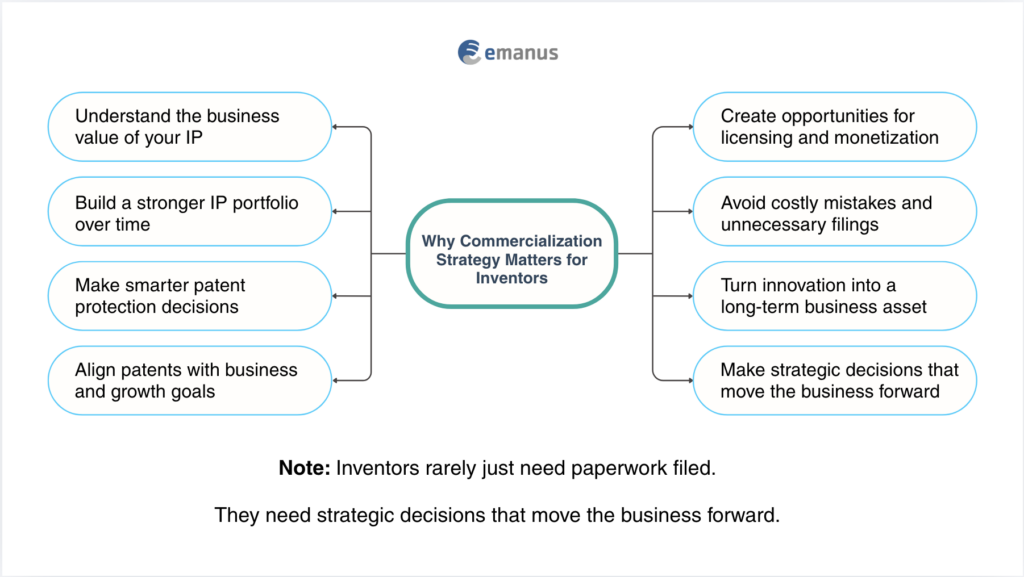
Every invention exists within a larger business story.
A healthcare startup has different IP priorities than a software company.
A solo inventor has different commercialization goals than a venture-backed AI startup.
The best commercialization-focused advisors help inventors:
- Understand the business value of their IP
- Make smarter protection decisions
- Build portfolios strategically over time
- Long-term patent monetization strategies
Inventors rarely just need paperwork filed.
They need strategic decisions that move the business forward.
What Inventors Should Actually Look For
Whether you choose a traditional invention company or an IP commercialization-focused partner, ask these questions first:
- Who will actually handle my work day-to-day?
- Will senior experts stay involved throughout the process?
- Does the team understand my technology and industry?
- Can they align IP decisions with business goals?
- Will they help prioritize commercialization opportunities?
- Are costs predictable as my company grows?
- Do they think strategically beyond filing paperwork?
The right partner should feel invested in your long-term success.
FAQs
- What’s the difference between a law firm and an IP commercialization firm?
A traditional law firm mainly focuses on legal protection like patents and trademarks, while an IP commercialization-focused firm also helps align intellectual property with business growth and market strategy.
- Do startups need Big Law firms for patent protection?
Not always. Many startups benefit more from IP firms that offer hands-on guidance, lower costs and more personalized support.
- Why is commercialization important after filing a patent?
A patent only creates value when it supports business goals like funding, licensing, product growth or competitive positioning.
- Are IP firms cheaper than large law firms?
In many cases, yes. IP firms often have lower overhead and more flexible pricing models, including flat-fee structures for startups and entrepreneurs.
- What should inventors look for in an IP partner?
Inventors should look for technical expertise, strategic thinking, transparent communication and a team that understands both innovation and business growth.
Final Thoughts
Choosing between a traditional law firm and an IP commercialization firm should reflect what you actually need as an inventor. If your goal is only to file patents, a traditional law firm may be enough.
But if your goal is to turn innovation into business value, commercialization-focused guidance becomes far more important. If you’re looking for guidance that connects intellectual property with commercialization, start a conversation with Emanus.
Contact our team today to explore how a commercialization-focused IP approach can help turn your innovation into a true competitive asset.