
You’ve spent countless nights creating something new. Maybe it’s a smart wearable device or a technical breakthrough.
Now comes the critical question: How do you protect it?
Many innovators assume filing a patent covers everything. But patent protection comes in two main categories: utility patents and design patents. Understanding the utility patent vs design patent distinction can mean the difference between strong protection and costly gaps.
Let’s break down the difference between utility and design patent protection so you can make the smartest choice for your invention.
What Is a Utility Patent?
If you’re wondering what a utility patent is, it is the most common type of patent that protects the functional aspects of an invention.
To define utility patent protection simply: it safeguards the technical features and operational processes behind an invention.
A utility patent can protect:
- A physical device or machine
- A step-by-step process or method
- Software or algorithms
- Manufacturing techniques
- Chemical or biological compositions
For example, if you invent a new engine system that improves fuel efficiency, a utility patent would protect the underlying technology and functionality.
Key Features of Utility Patents
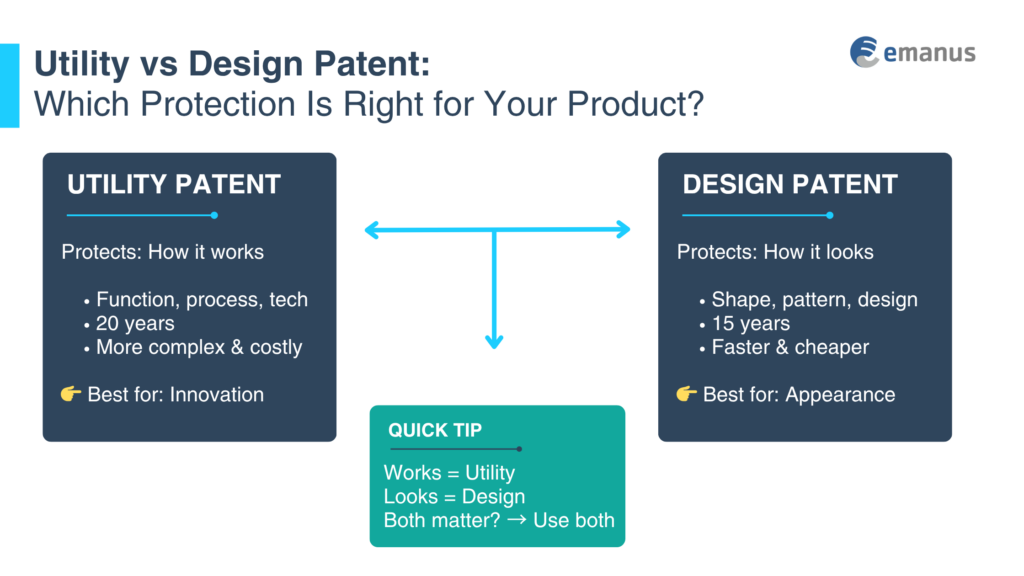
- Protection lasts 20 years from the earliest filing date
- Requires maintenance fees at 3.5, 7.5 and 11.5 years
- Typically more expensive and complex to obtain
- Applications often receive initial rejection from patent offices before approval
- Can provide broad protection depending on how claims are written
In short, utility patents are best when your innovation lies in how something works.
What Is a Design Patent?
A patent of design protects the ornamental or aesthetic appearance of a product.
This includes the visual elements that make a product unique, such as shape, pattern, surface or configuration.
For example, the distinctive shape of a smartphone, furniture design or consumer product packaging could be protected with a design patent.
Key Features of Design Patents
- Protection lasts 15 years from the grant date
- No maintenance fees are required
- Generally less expensive and faster to obtain
- Protection scope is narrower and limited to the design shown in the patent
Design patents are particularly valuable for products where visual identity and consumer appeal drive market success.
Quick Comparison: Utility vs Design
| Feature | Utility Patent | Design Patent |
| Protects | Function, structure or process | Appearance and ornamental design |
| Examples | Machines, software, manufacturing methods | Product shapes, packaging, decorative designs |
| Duration | 20 years from filing | 15 years from grant |
| Maintenance Fees | Required | Not required |
| Cost | Higher | Lower |
| Scope | Can be broad depending on claims | Narrower, limited to specific design |
In simple terms:
- Utility patents protect how a product works.
- Design patents protect how a product looks.
Can You Have Both?
In fact, smart innovators often use both to build a fortress of protection.
Example: A company developing a smart wearable device could:
- File a utility patent to protect the sensor technology and data processing.
- File a design patent to protect the watch’s unique shape and user interface.
This dual approach prevents competitors from copying either the technology or the visual design.
When to Choose Utility Patent
A utility patent is best if:
- Your innovation involves new technology, mechanical systems or software
- You’ve developed a manufacturing process or chemical composition
- The functional improvements are what make your product valuable
If your invention’s heart is how it operates, go for utility.
When to Choose Design Patent
A design patent is the right move if:
- Your product has a distinctive shape, pattern or ornamentation
- The visual appeal drives consumer choice
- You want faster, more cost‑effective protection
- The functionality is already known but your design is fresh
If your product’s look is its superpower, a patent of design is your shield.
Common Mistakes Innovators Make
- Filing only a design patent when the functionality is truly novel – competitors can copy the function.
- Assuming a utility patent automatically protects the product’s look – it doesn’t.
- Waiting too long – public disclosure before filing can destroy patent rights.
- Skipping professional help – patent law is complex, a mistake can be irreversible.
Queries
- Is there a difference between a utility and design patent?
A utility patent protects how an invention works or functions, while a design patent protects the ornamental appearance or visual design of a product.
- What are the three types of patents?
The three main types of patents are utility patents, design patents and plant patents, each protecting different types of inventions.
- Can you get both a design and utility patent?
Yes, a product can have both patents. A utility patent protects its functionality, while a design patent protects its appearance.
- How much does a utility patent cost vs design patent?
A utility patent typically costs $10,000–$20,000+ including filing and attorney fees, while a design patent usually costs $2,000–$5,000 depending on complexity.
- Should I get a design or utility patent?
If your innovation lies in how the product functions, you need a utility patent. If it lies in how the product looks, a design patent may be more suitable.
Takeaway
Choosing between a utility patent and a design patent depends on what makes your product unique.
If your innovation lies in how it works, a utility patent provides strong protection for its functionality. If the competitive advantage comes from how it looks, a design patent safeguards its visual identity.
In many cases, the best strategy is to combine both patents to protect your product from every angle.
Before launching your innovation, ensure your intellectual property strategy is strong and complete. Secure the right patent protection and protect your product’s future with expert guidance from Emanus.