

Innovation no longer stays local and neither do copycats. Today’s startups launch globally, manufacture across borders, and compete in markets they never planned for. In this fast-moving world, protecting your invention in just one country can leave serious gaps. That’s where PCT filing becomes a game-changer for international applicants.
Heading into 2026, the Patent Cooperation Treaty (PCT) is a smart choice for innovators who want global protection without burning capital too early. This guide explains how PCT filing works, who should use it, and how to turn it into a winning global patent strategy.
What Is PCT Filing and Why It Matters in 2026
For many first-time applicants, the question is simple: what is PCT filing and why is it so important?
PCT filing refers to submitting a patent application under the Patent Cooperation Treaty, an international system used by more than 150 countries. Instead of filing separate patent applications in multiple countries at once, applicants can start with a single international application.
In 2026, rising patent prosecution costs and stricter examination standards make PCT filing especially valuable. It provides broad international coverage while allowing applicants to delay major expenses and strategic decisions.
Who Should Consider PCT Filing
PCT filing is especially useful for:
- Startups planning international expansion
- Innovators seeking foreign investors or licensees
- Companies unsure which countries will become key markets
- R&D teams developing globally relevant technology
If your invention has potential beyond one country but you’re not ready to commit to multiple national filings, PCT filing is the smartest first step.
How PCT Filing Actually Works
PCT filing does not give you a “worldwide patent.” Instead, it creates a single international application that later enters individual countries.
The process works in two main phases:
1. International Phase
You begin by filing a PCT application through your national patent office or directly with WIPO. During this phase:
- Your invention gets an international filing date
- An International Search Report (ISR) is issued
- A written opinion assesses patentability
This phase helps you understand the strength of your invention before spending heavily on national filings.
2. National Phase
Around 30–31 months from your earliest filing date, you choose specific countries (like the US, Europe, China or Japan) and enter the national phase. Each country then examines your application under its own laws.
How to Do PCT Filing (Step-by-Step)
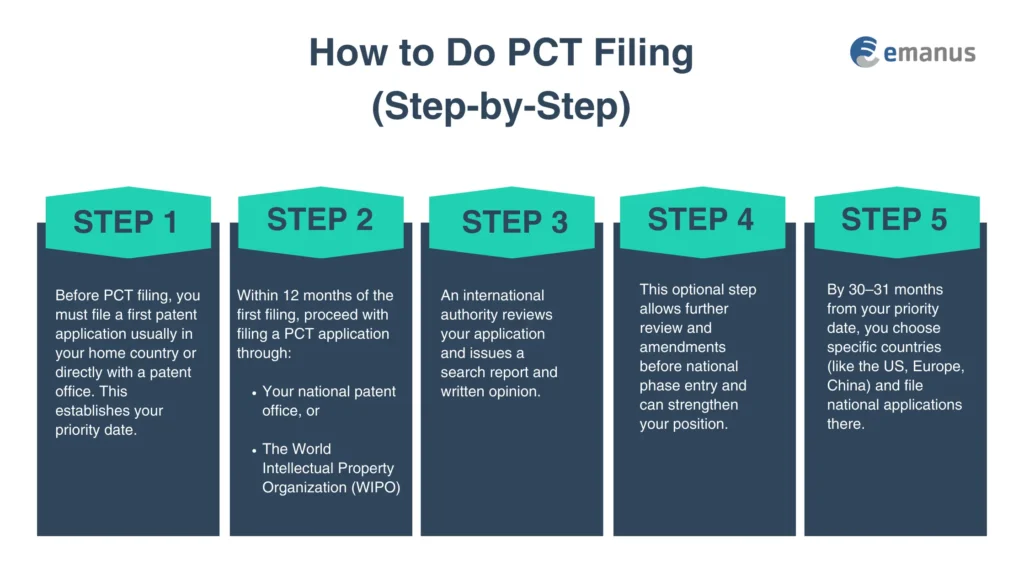
Step 1: File a First (Priority) Patent Application
Before PCT filing, you must file a first patent application usually in your home country or directly with a patent office. This establishes your priority date.
Step 2: File the PCT Application (Within 12 Months)
Within 12 months of the first filing, proceed with filing a PCT application through:
- Your national patent office, or
- The World Intellectual Property Organization (WIPO)
Step 3: Receive the International Search Report (ISR)
An international authority reviews your application and issues a search report and written opinion.
Step 4: Optional International Preliminary Examination
This optional step allows further review and amendments before national phase entry and can strengthen your position.
Step 5: Enter the National Phase (Around 30 Months)
By 30–31 months from your priority date, you choose specific countries (like the US, Europe, China) and file national applications there.
(Infographic Concept: PCT Filing Step-by-Step Flowchart)
Why PCT Filing Is Strategic for International Applicants
One of the biggest advantages of PCT filing is time. Instead of deciding immediately where to file, you gain up to 30 months to:
- Test market demand
- Raise funding
- Refine your product
- Evaluate competition
This flexibility is valuable for startups and growing businesses in 2026’s competitive environment.
Cost Planning and Budget Control with PCT Filing
Filing patents globally can be expensive. PCT helps manage costs by:
- Delaying high national filing fees
- Reducing duplication of early-stage work
- Allowing better budgeting across funding cycles
While PCT filing fees still apply later during the national phase, applicants are able to make more informed and data-driven decisions by then.
Common Mistakes International Applicants Make with PCT Filing
Despite its benefits, PCT filing is often misunderstood. Common mistakes include:
- Assuming PCT grants automatic patent rights
- Missing national phase deadlines
- Filing weak initial applications
- Choosing countries without market justification
Choosing Countries Wisely in the National Phase
Not every country needs to be covered. Most global patent activity is concentrated in a few regions:
- United States
- Europe
- China
- Japan
- South Korea
Successful applicants choose countries based on where they sell, manufacture or face competition, not just prestige.
Life After PCT: Turning Protection into Value
Once national patents are granted, the focus shifts to:
- Maintenance fee planning
- Enforcement strategies
- Licensing and monetization
- Portfolio optimization
Global protection is not just defensive. It’s a growth asset when managed well.
Common Questions
- What does PCT mean in court?
In court, a PCT application does not give enforceable patent rights. It only shows that you’ve applied for international protection. Legal enforcement happens only after national patents are granted.
- When must a PCT application be filed?
A PCT application must be filed within 12 months of your first priority patent filing.
- Who can file a PCT?
Anyone who is a citizen or resident of a PCT member country can file a PCT application. This includes individuals, startups, companies, universities and research institutions.
- How much does a PCT filing cost?
Initial PCT filing costs usually range from USD 3,000 to USD 5,000, depending on fees, translations and attorney support. National phase costs later can be much higher.
- What does PCT stand for?
PCT stands for Patent Cooperation Treaty, an international agreement that simplifies patent filings across multiple countries.
- What are the risks with filing a PCT application?
The biggest risks include high long-term costs, missing national phase deadlines and filing a weak initial application.
Final Thoughts: Building Global IP the Smart Way
In 2026, innovation is global by default and protection must be too. PCT filing offers international applicants a practical and flexible path to global patent protection without rushing into costly decisions. When used strategically, it helps innovators move faster, smarter, and with confidence across borders.
If global protection is part of your growth plan, now is the time to act. Talk to Emanus to map the right PCT filing strategy and take the next step toward secure international patent protection.