Stop filing patents like it’s the 19th century. In today’s global economy, your idea needs a passport- not a pile of separate applications.
The Patent Cooperation Treaty (PCT) is that passport. For founders and innovators eyeing international markets, the PCT patent application system is a critical shield that protects your IP rights. This guide explains the PCT application process and how to use it to protect your invention across 150+ countries with one smart, powerful move.
What is the PCT System
The PCT system, administered by the World Intellectual Property Organization (WIPO), allows inventors to file one international patent application that can later be extended to over 150 countries.
Instead of rushing into multiple national filings, the PCT gives you:
- A single filing process
- More time to evaluate markets
- Early insight into patentability
- Flexibility to plan global expansion strategically
In a world where innovation cycles are shorter and international competition is intense, the PCT application process has become a foundation for global IP strategy.
If you’re looking for a strategic overview of timelines, costs, and filing pathways, explore our detailed guide on PCT filing before beginning the application process.
Why the PCT System is Beneficial for Inventors
The PCT application patent gives you:
- One Application, Global Reach
- Deferred Costs and Decisions
- Early Patentability Insights
- Strong Deterrence Against Copycats
Step-by-Step Guide to the PCT Application Process
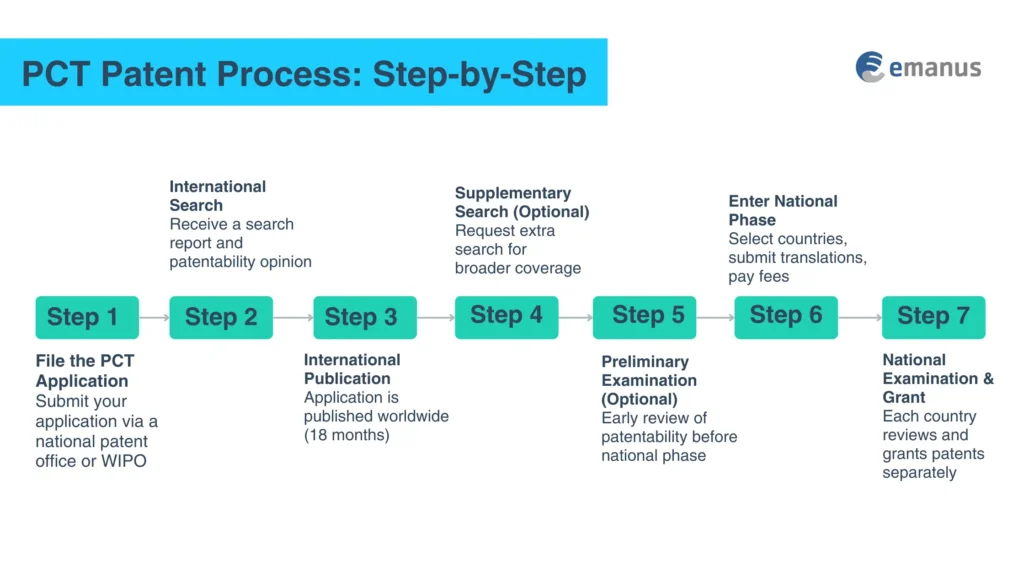
Step 1: File the International Application
To file under the PCT, you must be a national or resident of a PCT Contracting State. You submit your PCT application to:
- A national patent office or
- The International Bureau of WIPO
Your application must include:
- A request form
- Detailed description of the invention
- Patent claims
- Drawings (if applicable)
- An abstract
Remember: Your filing language must be accepted by the receiving office, though translations may be required later.
Step 2: International Search
After filing a PCT application, your submission undergoes an international search conducted by an International Searching Authority (ISA).
Within 16 months of the priority date, you receive:
- An International Search Report (ISR)
- A written opinion on patentability
Step 3: International Publication
At 18 months from the priority date, your PCT application is published internationally along with the ISR.
Step 4: Optional Supplementary International Search
If your invention involves regions or languages not fully covered by the initial search, you can request a supplementary international search.
This must be done within 19 months of the priority date and comes at an additional cost but it can reduce surprises later.
Step 5: Optional International Preliminary Examination
This optional step provides a deeper evaluation of patentability before entering national phases.
You must file a demand by 22 months from the priority date.
Step 6: Entering the National Phase
This is where international strategy turns into country-specific action.
Typically by 30 months from the priority date, you must:
- Choose the countries you want protection in
- Submit translations
- Pay PCT application fees
- Meet local legal requirements
Step 7: National Examination and Grant
National patent offices review your application independently. Approval depends on:
- Local patent laws
- Examination standards
- Compliance with national requirements
Successfully navigating this phase determines where your PCT application patent rights are finally granted.
Smart Tips to Streamline Your PCT Strategy in 2026
- File early to lock in priority
- Use ISR feedback to refine claims
- Be selective about national phase countries
- Align patent decisions with real business goals
- Plan budgets for post-PCT national costs
The PCT is most powerful when used as a decision-making framework, not just a filing tool.
PCT vs Direct National Filings: Which Is Better?
Before choosing between PCT and Direct National Filings, consider the following factors:
|
Factor |
PCT Route |
Direct Filings |
| Upfront Cost | Higher initially | Lower per country |
| Long-Term Cost | Efficient for 2+ countries | Adds up quickly |
| Decision Time | Up to 30 months | Immediate |
| Speed | Slower overall | Faster locally |
| Flexibility | High | Low |
| Risk Level | Lower early risk | Higher early risk |
Is the PCT Route Right for You?
Not sure which path fits your situation? Use this quick checklist.
Ask Yourself:
- Planning to enter 2 or more foreign markets?
- Still validating the commercial potential of your invention?
- Need time to attract investors or partners?
- Unsure which countries matter most for protection?
- Want early feedback on patentability before spending big?
Your Result:
- If you answered mostly yes, the PCT application process is likely a strong fit.
- If you answered more no, Direct national filings may be the smarter move.
Final Takeaway: Think Global, File Strategically
The PCT is more than a treaty- it’s a strategic framework for global ambition. The PCT application process simplifies international patenting while keeping control firmly in your hands. With the right planning, it allows you to test markets, attract investors, and refine your strategy before entering national phases.
In today’s competitive global landscape, the PCT is impossible to ignore. It gives scale-ready innovators a clear strategic advantage.
FAQ’s
- What is needed to file a PCT application?
A detailed description of your invention, patent claims, drawings (if applicable), inventor details, and filing fees. - When should I file a PCT application?
Typically within 12 months of your first patent filing to preserve international priority rights. - How much does a PCT application cost?
In 2026, most applicants spend USD 3,000–5,000+, depending on fees, translations, and professional support. - What does PCT mean for a patent?
It allows you to seek protection in multiple countries through one application, but it does not grant a global patent. - Can I file a PCT application without a lawyer?
Yes, but working with a patent professional helps avoid costly mistakes and improves success in national phases. - What does PCT stand for?
PCT stands for Patent Cooperation Treaty, an international system for filing patents across multiple countries.