

Picture this: a medical device startup spends three years and millions of dollars developing a breakthrough product. Patents are filed. Launch day arrives. Then within weeks, a patent infringement lawsuit lands- threatening to halt sales and drain the company’s cash.
The culprit? They skipped a Freedom to Operate (FTO) analysis.
In a world where millions of patents are filed every year, an FTO analysis helps you identify risks before they sink your business. For startups and innovators, FTO is essential risk management.
What Is Freedom to Operate (FTO)?
Freedom to Operate (FTO) is a legal assessment that determines whether a company can develop, manufacture, use or sell a product without infringing active patents held by others.
Simply, FTO means confirming whether you have the legal freedom to commercialize your technology.
It is important to understand that FTO is different from a patentability search.
In simple terms:
- Patentability asks: “Can we patent this idea?”
- FTO asks: “Can we sell this product without infringing someone else’s patent?”
Even if your invention is patentable, it could still infringe an existing patent. That’s why freedom to operate search is a critical step before commercialization.
Why FTO Analysis Is Critical Before Product Launch
Launching a product is exciting. But without an FTO analysis, you risk:
- Costly lawsuits – litigation can cost millions and derail your entire business.
- Wasted R&D – developing a product you can’t legally sell.
- Investor cold feet – investors expect clean IP, FTO proves you’ve done your homework.
Key Benefits of an FTO Analysis
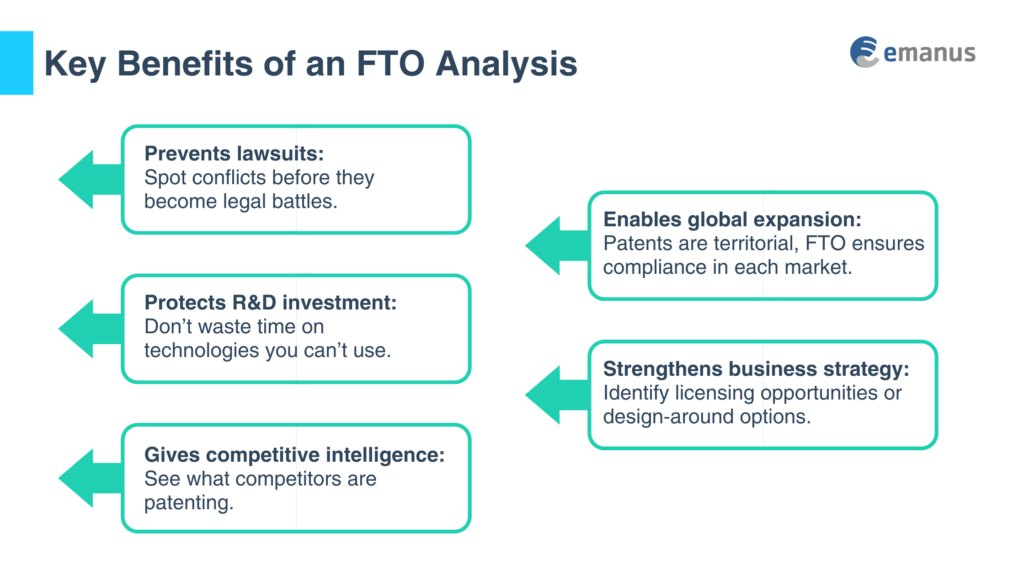
- Prevents lawsuits: Spot conflicts before they become legal battles.
- Protects R&D investment: Don’t waste time on technologies you can’t use.
- Gives competitive intelligence: See what competitors are patenting.
- Enables global expansion: Patents are territorial, FTO ensures compliance in each market.
- Strengthens business strategy: Identify licensing opportunities or design‑around options.
Key Elements to Examine in an FTO Analysis
A professional FTO search examines several layers:
- Technical scope – exactly what features, components and functions does your product have?
- Jurisdiction – where will you manufacture, sell or import?
- Patent status – are the relevant patents still active?
- Claim analysis – do the patent’s legal claims cover your product?
Example of FTO in Action
A startup developing a smart wearable health device runs an FTO analysis and discovers that a key sensor component is covered by an existing patent.
Instead of abandoning the project, they negotiate a licensing agreement with the patent holder. The product launches on time, legally and the startup avoids a lawsuit.
That’s the power of FTO: turning a potential roadblock into a strategic move.
The Freedom to Operate (FTO) Process
Conducting an FTO analysis involves several structured steps.
1. Patent Landscaping
The process begins with mapping existing patents within the relevant technology field. This identifies patents that could impact the product.
2. Legal Status Verification
Verifying legal status ensures that only relevant patents are considered.
3. Infringement Analysis
For active patents, analysts conduct a detailed comparison between the product and patent claims to determine potential infringement.
4. Risk Assessment
Once potential conflicts are identified, the level of risk is evaluated. This helps businesses understand the likelihood and consequences of infringement.
5. Mitigation Strategies
If risks exist, companies can adopt several strategies, such as redesigning product features, negotiating licensing agreements or challenging patent validity.
How Long Does an FTO Analysis Take?
The timeline depends on the complexity of the technology and the geographic scope.
Most comprehensive FTO analyses take 4–8 weeks.
| Phase | Duration |
| Planning and scoping | 1–3 days |
| Patent database search | 3–7 days |
| Initial screening | 5–10 days |
| Detailed claim analysis | 10–20 days |
| Final report preparation | 3–5 days |
Best Practices for an Effective FTO
- Start early – do it while you can still make design changes.
- Collaborate – engineers, legal and product teams should work together.
- Document everything – showing good‑faith efforts can help if disputes arise.
- Monitor continuously – new patents are published all the time, stay updated.
- Think globally – if you plan to sell abroad, include those jurisdictions.
Quick FTO Answers
- What does FTO mean?
FTO stands for Freedom to Operate. It refers to an analysis that determines whether a product, technology or process can be commercially used, manufactured or sold without infringing existing patents. - Is there a difference between a patent and FTO?
A patent protects your invention and gives you exclusive rights to it, while FTO analysis checks whether your product might infringe patents owned by others before commercialization. - How much does an FTO analysis cost?
A professional FTO analysis typically costs between $15,000 and $50,000, depending on technology complexity, geographic scope and the depth of the patent search. - What is an FTO investigation?
An FTO investigation involves conducting detailed patent searches and claim analysis to identify existing patents that could potentially block or affect the commercialization of a new product. - What are the drawbacks of FTO?
FTO analysis can be time-consuming and costly, and it cannot guarantee absolute protection since new patents may be granted after the analysis is completed.
Conclusion: Don’t Let a Patent Landmine Derail Your Success
Innovation brings new ideas to life- but without a clear view of the patent landscape, even the most promising product can face legal challenges.
A Freedom to Operate (FTO) analysis gives you the clarity you need to move forward with confidence.
Whether you’re a solo inventor or a fast‑growing startup, FTO is a small investment that can save you millions. Before you launch your next product, make sure you truly have the freedom to operate.
At Emanus, we help innovators and entrepreneurs conduct comprehensive FTO analyses that are clear and tailored to their business goals.
Contact us today to schedule a consultation- and protect your path to market.