Artificial intelligence has changed how innovators create new products, software, and business solutions. Today, many breakthroughs begin with a carefully crafted AI prompt instead of a whiteboard sketch.
That raises an important question:
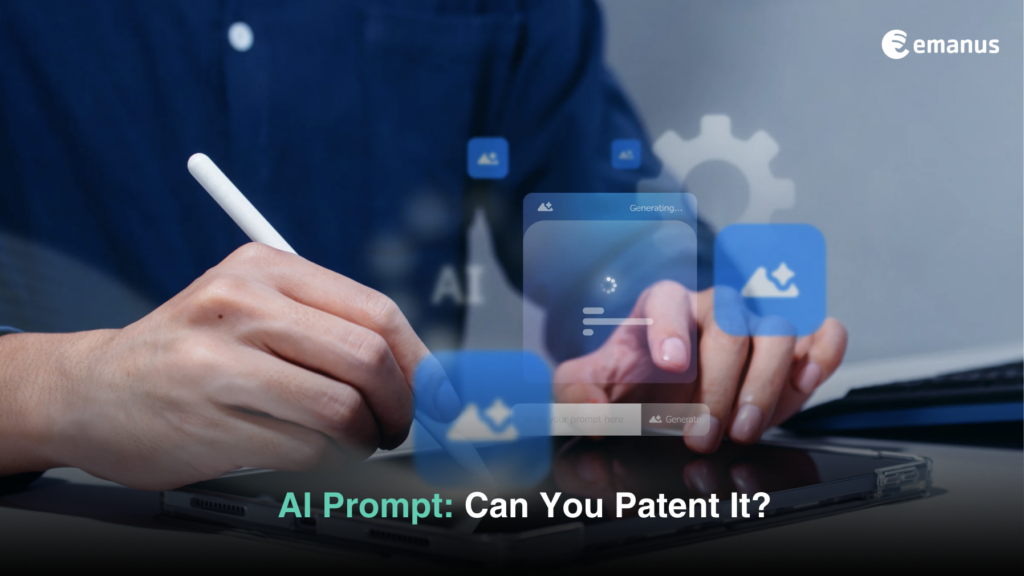
Can you patent an AI prompt?
The short answer is:
Sometimes yes, but not simply because it’s a good prompt.
The USPTO has not created a special patent for AI prompts. Instead, it evaluates inventions involving AI under existing patent law, focusing on the human inventor’s contribution.
Here’s what inventors, startups and AI companies need to know in 2026.
What Is an AI Prompt?
An AI prompt is the instruction you give an AI model, such as ChatGPT or another large language model (LLM), to generate an output.
Examples include:
“Design a lightweight drone frame for agricultural spraying.”
“Generate code for a scheduling algorithm.”
“Suggest a new battery cooling system.”
Some prompts are simple. Others represent months of experimentation and industry expertise.
The question is whether those prompts themselves qualify for patent protection.
Can You Patent an AI Prompt?
There isn’t a simple yes or no answer.
A prompt by itself is usually not patentable.
However, a prompt may become part of a patentable invention if it contributes to a new, useful, and non-obvious technological solution. Patentability still depends on the same legal requirements that apply to every invention, including novelty, usefulness and non-obviousness.
In other words:
The USPTO doesn’t ask, “Is this a prompt?”
It asks, “Is there a patentable invention created through meaningful human innovation?”
To explore more on patent eligibility for AI innovation, visit:
USPTO issues AI subject matter eligibility guidance.
What the USPTO Actually Says
One common misconception is that the USPTO has created special rules for AI prompts. It hasn’t.
Instead, the USPTO says:
- AI is a tool, not an inventor.
- Only humans can be named as inventors on a patent.
- AI-assisted inventions can still receive patents if a human made the inventive contribution.
Interestingly, the USPTO has also explained that creating a prompt may contribute to inventorship in some situations, but simply typing instructions into an AI system does not automatically make someone an inventor. The key question is whether the human made a meaningful contribution to the claimed invention.
When Could an AI Prompt Support a Patent?
Imagine two different scenarios.
Example 1: Probably Not Patentable
You ask ChatGPT: “Design a better coffee mug.”
The AI suggests a new handle shape.
You submit exactly what the AI generated without adding your own inventive work.
This is unlikely to support a patent because the prompt itself isn’t the invention, and simply requesting ideas from AI doesn’t establish inventorship.
Example 2: Potentially Patentable
Now imagine you’re developing a new medical device.
You create a highly specialized series of prompts that help generate dozens of design options.
You evaluate them, combine features, improve the design, build prototypes, and solve technical problems through your own expertise.
In this case, the overall invention may qualify for patent protection because the human inventor contributed the inventive concept. The prompts may become part of the development story, but the patent protects the invention, not merely the instructions given to AI.
Why Some Experts Believe Certain Prompts Could Be Patentable
Some patent professionals argue that certain highly technical prompts resemble traditional patent claims.
For example, a prompt that precisely describes:
- a new machine,
- a manufacturing process,
- or a software algorithm,
might define an entire class of inventions rather than simply asking AI to “generate ideas.”
Under that view, if the prompt itself describes a novel, useful, and non-obvious invention in enough detail, there could be a case for patent protection.
However, this remains an evolving legal discussion rather than settled USPTO policy. Patentability would still need to be evaluated on a case-by-case basis.
Can LLMs Be Patented?
Yes, in many cases.
A large language model itself may be patentable if the invention includes new technology, such as:
- improved model architecture,
- novel training methods,
- new inference techniques,
- unique AI hardware,
- or other technical innovations.
Simply using an existing LLM like ChatGPT, however, does not make an invention patentable.
The innovation must come from what humans created, not from the AI tool itself.
Can You Sell AI Prompts?
Yes.
Many businesses sell:
- prompt libraries,
- prompt templates,
- industry-specific prompts,
- AI workflow systems,
- prompt engineering services.
Selling prompts is generally legal.
The challenge is preventing competitors from copying them, which is why many businesses rely on:
- copyright,
- contracts,
- trade secrets,
- licensing agreements,
- or patents for the underlying technology where appropriate.
How to Better Protect AI-Based Innovation
If your business develops AI-powered technology, think beyond the prompt itself.
Instead, document how your invention works, the technical problem it solves, your design decisions, your testing process, your improvements beyond AI-generated suggestions, and your own inventive contributions.
Strong documentation makes it much easier to demonstrate human inventorship if you later pursue patent protection.
AI Prompts Frequently Asked Questions
- Are AI prompts patentable?
Sometimes. A prompt alone is usually not patentable. However, if it forms part of a novel, useful and non-obvious invention with meaningful human contribution, it may support a patent application as part of the overall invention.
- Can an AI prompt be copyrighted?
Yes. The written text of an original prompt may qualify for copyright protection as creative expression. Copyright protects the wording, not the underlying idea or technical concept.
- What is the 30% rule for AI?
There is no official USPTO or U.S. copyright “30% rule” for AI. The phrase often appears online, but it is not a recognized legal standard for determining ownership, copyright, or patentability.
- Can I sell AI prompts?
Yes. Many businesses successfully sell prompt libraries, custom prompts, and AI workflow templates. Depending on your business model, you may also protect them using contracts, copyright, licensing or trade secret strategies.
Conclusion
AI is transforming how inventions are created, but patent law still rewards human ingenuity, not AI-generated ideas alone. The most valuable intellectual property is still the innovation, technical solution and inventive contribution behind it.
Emanus helps startups, founders, and technology companies identify patentable AI innovations, document human inventorship, and develop IP strategies that align with today’s evolving legal landscape. Whether you’re building AI-powered software, developing new LLM technologies, or creating products with generative AI, we can help you protect what truly sets your innovation apart.
Have an AI-driven invention? Consult Emanus today to explore whether your innovation is patentable and build an IP strategy designed for the future.