What if one missed payment could wipe out years of innovation?
That’s exactly what happened to one of most influential Terrence Howard patents filing.
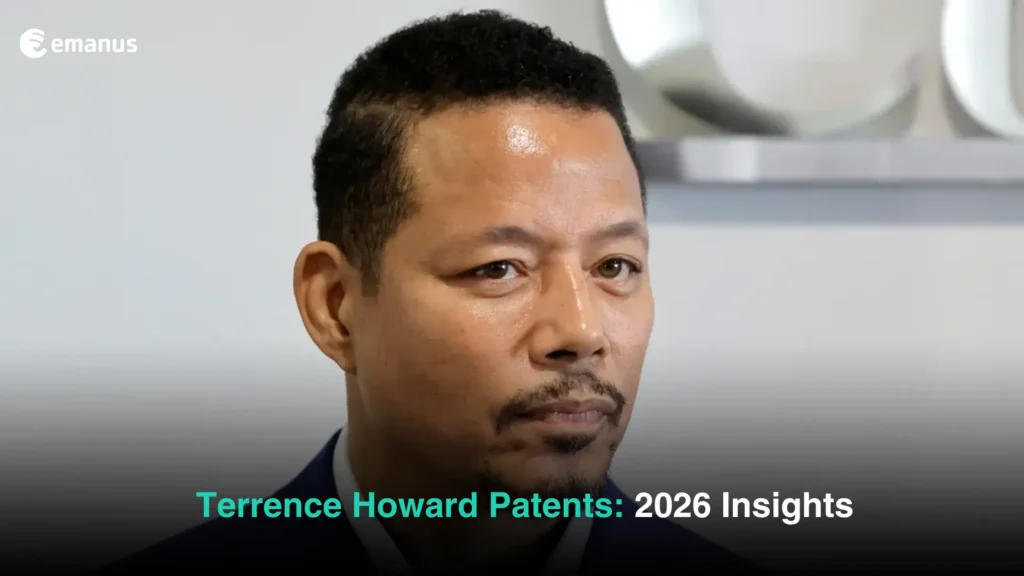
Between 2009 and 2024, Hollywood actor Terrence Howard built an impressive patent portfolio with 79 applications and 60 granted patents. But a virtual reality invention that later influenced multiple patent examinations never became an enforceable right because it was abandoned after maintenance fees went unpaid.
For startups, this isn’t celebrity trivia. It’s a case study in how patents are lost because the strategy behind protecting it fell apart. The public filing history reveals lessons every founder should understand before building an IP portfolio.
The Numbers: What Terrence Howard’s Patent Portfolio Actually Contains
Terrence Howard patent list holds 79 total patent filings across 36 distinct patent families, of which 60 were granted and 59 remain active, according to portfolio data compiled by patent analytics firm GreyB. Twenty applications are now dead. That ratio (roughly 75% active) is high enough to indicate a well managed portfolio.
| Metric | Figure |
| Total patent filings | 79 |
| Patent families | 36 |
| Granted patents | 60 |
| Active patents | 59 |
| Dead/abandoned patents | 20 |
| Filing span | 2009 – present |
| Peak filing year | 2014 (26 applications) |
| Primary filing jurisdiction | United States, then Canada and Europe |
The filing pattern itself is the first data point worth examining as a case study. A single patent filed in isolation tells you almost nothing about an inventor’s intent. Thirty-six related families, filed continuously over more than a decade, with a concentrated surge of 26 applications in 2014, is the signature of a portfolio strategy.
Case Study: The Patent That Was Cited 51 Times Then Abandoned
The case study centers on a single filing: US20100271394A1, submitted in 2010, describing a system for merging virtual reality content with real-world environments. It was cited during the examination of 11 separate later patent applications, contributing to 51 patent rejections including against filings from GoPro, Apple, Amazon, and Hewlett-Packard. In 2013, before the patent was granted, Howard stopped paying the required maintenance fees, and the application was formally abandoned.
Examiner citation activity, which is a patent being used as prior art against other companies’ applications, is one of the strongest available signals of real technical relevance. It means patent examiners, independently and repeatedly, judged the invention close enough to later filings that it blocked or narrowed those applications’ claims.
The result is a filing with a documented technical footprint across multiple companies’ patent applications, discarded over a recurring maintenance cost before it ever became an enforceable right.
Why Did Terrence Howard Abandon His Patent?
Howard abandoned US20100271394A1 in 2013, three years after filing, by choosing not to pay the maintenance and annuity fees required to keep the application moving toward grant. He has since described regretting the decision, telling podcast host Joe Rogan in 2024 that he believed the underlying technology had gone on to generate massive commercial value he never captured.
The distinction that matters for any founder reading this case study: filing a patent application and holding a granted patent are not the same legal status. A filing is a request for protection under examination; a grant is the enforceable right itself.
Does a Founder Need a PhD to Build a Defensible Patent Portfolio?
No. The USPTO does not require academic credentials to file or be granted a patent, only a complete, technically sound invention disclosure that meets novelty and non-obviousness standards. Terrence Howard holds no PhD and is not a credentialed scientist, yet 60 of his 79 filings were granted.
This is most relevant to early-stage founders without engineering backgrounds: the patent office evaluates the disclosure, not the inventor’s resume. A non-technical founder with a genuinely novel mechanism, properly documented and filed through a registered patent agent, is evaluated on identical criteria to an engineer with a doctorate. Credentials affect credibility in public discourse. They do not affect patent examination.
Patent Maintenance: The Failure Point Most Startups Repeat
The mechanism that destroyed Howard’s most valuable filing was unpaid maintenance fees. It is the single most common and most preventable way startups lose patent assets. The USPTO requires maintenance fee payments at 3.5, 7.5, and 11.5 years post-grant to keep a patent enforceable; pending applications carry their own ongoing prosecution costs. Cash-constrained startups deprioritize these payments during budget cuts.
Maintenance failure checklist:
- Is every maintenance fee deadline calendared independently of your law firm’s reminder system?
- Is patent maintenance budgeted as a fixed recurring cost, not discretionary legal spend?
- Have you reviewed examiner citation activity on your pending applications in the last 12 months?
- If a filing were abandoned today, do you know the reinstatement cost versus the cost of permanent loss?
- Has a registered patent agent reviewed your portfolio’s commercial alignment in the past year?
If any answer is no, you likely face the same risk that Howard did.
What This Case Study Means for Startup Patent Strategy
The lesson is that a technically influential, examiner-cited, multi-jurisdiction patent filing was lost entirely to a single missed category of payment.
Terrence Howard’s invention’s technical merit was independently validated three separate ways: grant rate, citation count, and rejection impact against major technology companies. None of that validation mattered once the maintenance lapsed.
For founders building an IP portfolio in 2026, the actionable takeaway is:
- track examiner citations as an early commercial-relevance signal,
- treat maintenance fees as protected non-discretionary spend, and
- don’t let academic background determine whether an invention is worth filing.
Summing Up
Terrence Howard patents portfolio proves that valuable intellectual property isn’t lost only because an invention lacks merit. Sometimes, it’s lost because the strategy behind protecting it falls short.
A patent that influenced later innovations and shaped multiple patent examinations ultimately became unenforceable because of a preventable administrative lapse. For startups and innovators, filing a patent is only one step in building an IP asset. Long-term value depends on thoughtful portfolio management and timely maintenance.
Have an invention worth protecting? Contact Emanus to build a patent strategy that safeguards your innovation today while positioning it for growth tomorrow.
Frequently Asked Questions
- How many patents does Terrence Howard have?
79 total patent filings across 36 patent families, with 60 granted and 59 currently active, according to GreyB’s portfolio analysis. It is a sustained filing record spanning 2009 to the present.
- Why did Terrence Howard abandon his patent?
He stopped paying required maintenance and annuity fees on his 2010 virtual reality patent application in 2013, three years after filing and before the patent was granted, resulting in formal abandonment of a filing that had already been cited in 11 separate patent examinations.
- Does Terrence Howard have a PhD?
No. He holds no PhD or formal scientific credential. The USPTO does not require academic credentials for patent filing or grant, which is why 60 of his 79 applications were granted independent of his lack of formal scientific training.
- What did Terrence Howard invent?
His patent filings span structural and geometric design systems, immersive and sensory technologies including virtual and augmented reality, and mechanical or propulsion-related systems. It is a broader technical range than typical celebrity patent portfolios. - What is Terrence Howard’s most cited patent?
US20100271394A1, his 2010 virtual reality application, with 50 total citations and direct examiner-level citation against 11 later applications, contributing to 51 rejections of filings from companies including GoPro, Apple, and Amazon before it was abandoned in 2013.