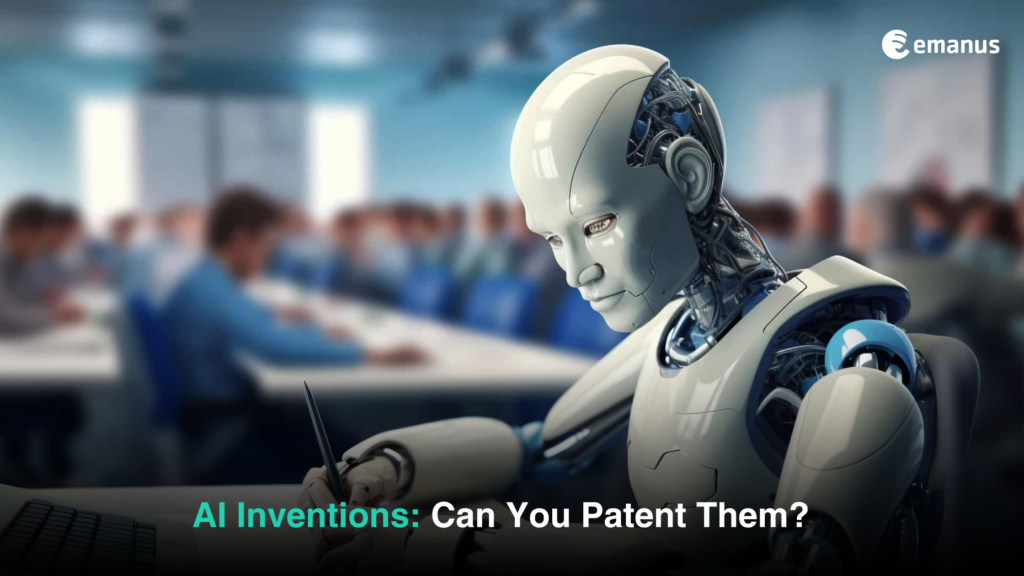
You feed a prompt into an AI. Minutes later, it generates a breakthrough design for a medical device. Brilliant. But who owns it? AI Inventions are happening at a pace humans can’t match. But the patent system was built for people.
So where does that leave you- the entrepreneur, the innovator, the business owner trying to protect your edge? The answer isn’t simply yes or no. But it is something you can navigate. Let’s walk through what’s patentable, what isn’t and how to keep your AI-powered ideas safe.
Why AI Innovation is Booming
AI is accelerating inventions like never before. Technology patents are evolving rapidly to keep up with this new wave of innovation. AI can:
- Analyze millions of data points in seconds
- Generate novel solutions to complex problems
- Suggest improvements humans might miss
Startups and enterprises are using AI to discover new drugs, optimize supply chains and create business models that didn’t exist five years ago.
Can AI Be an Inventor? Understanding the Legal Reality
One of the most debated topics in intellectual property today is whether AI can be listed as an inventor.
Human inventorship requirement
Under current laws in most countries, including the United States and the UK, only a human can be named as an inventor.
This principle was reinforced by multiple legal decisions, including the well-known DABUS case. Courts consistently ruled that AI systems are not “natural persons,” and therefore cannot qualify as inventors.
Key legal rulings shaping AI patents
The legal consensus is clear:
- AI cannot be listed as an inventor
- Owning an AI system does not grant ownership of its outputs
- Human contribution is mandatory for patent protection
This doesn’t mean AI inventions are unpatentable. It just means a human must play a meaningful role in filing AI patent applications.
What Makes an AI‑Assisted Invention Patentable?
Here’s the good news: AI inventions can be patented if a human makes a significant contribution.
The “Significant Contribution” Rule
Patent offices look for meaningful human input, such as:
- Designing the AI system for a specific task
- Creating unique prompts or training data
- Interpreting and refining AI outputs into a working invention
- Solving a technical problem that the AI couldn’t see on its own
Technical Effect vs. Abstract Idea
For an AI invention to be patentable, it must solve a real technical problem or deliver a measurable improvement.
| Likely Patentable | Not Patentable |
| AI that improves medical image diagnosis | AI that writes marketing taglines |
| Predictive maintenance in manufacturing | AI‑generated business reports |
| Autonomous driving safety system | Generic data presentation |
Common Misconceptions
- “AI can’t be patented at all.”
False. AI‑based inventions can be patented. Abstract AI algorithms cannot. - “If AI created it, I automatically own it.”
No. You need documented human contribution. - “Software is never patentable.”
Not true. Software that produces a technical effect may qualify under modern artificial intelligence patents frameworks.
Types of AI Innovations That Can Be Patented
These sectors are driving a surge in technology patents built around AI capabilities.
- Healthcare – AI diagnostic tools, drug discovery systems
- Manufacturing – Predictive maintenance, quality control AI
- Automotive – Autonomous driving, collision avoidance
What Usually Doesn’t Qualify
- Pure business methods
- Abstract algorithms without a specific technical use
- Simple data presentation or visualization
The Role of Human Contribution in AI Innovation
Even in AI-driven development, humans remain central.
Prompt design and training
Crafting the right prompts or training data can significantly influence AI outputs. This input can count as a meaningful contribution.
Interpreting AI outputs
Turning raw AI output into a usable invention requires human judgment. This step is critical for successful AI patent applications.
AI and the Patent Application Process
Filing a patent for an AI invention involves unique considerations.
Disclosure requirements
You must provide enough detail for someone skilled in the field to replicate the invention. This includes explaining how the AI contributes to the solution.
Static vs dynamic AI models
- Static AI: May require less disclosure
- Dynamic AI: Often needs detailed explanation of learning processes and data
Step‑by‑Step: Protecting Your AI Invention
- Identify the technical problem
- Document human contribution
- Avoid early disclosure
- Conduct a patent search
- File a provisional patent
- Work with an IP expert
Global Perspective: How Different Regions Handle AI Patents
| Region | AI as Inventor? | Human Contribution Required? |
|
USA |
No |
Yes |
|
UK |
No |
Yes |
|
Europe |
No |
Yes |
|
China |
No (but more flexible on AI‑assisted inventions) |
Yes |
Most countries agree: AI is a tool, not an inventor. But filing strategies vary, get local advice if you’re going global with your AI patent applications.
AI Inventions Mostly Asked Questions
- Can AI inventions be patented?
Yes, AI-assisted inventions can be patented if a human makes a significant contribution. The invention must also solve a technical problem or provide a measurable improvement.
- Can AI be listed as an inventor?
No, current laws require a human inventor. AI is considered a tool, not a legal entity capable of inventorship.
- What counts as a “significant contribution”?
It includes designing the system, crafting inputs, training the model or refining outputs into a usable invention.
- Are AI algorithms patentable?
Algorithms alone are usually not patentable. However, when applied to solve a real technical problem, they may qualify.
- What happens if I disclose my AI invention early?
Public disclosure before filing can make your invention unpatentable. Always secure protection first or use NDAs.
- Do patent laws differ globally for AI?
Yes, but most countries agree that AI cannot be an inventor. However, filing strategies may vary by region.
Don’t Let Your AI Breakthrough Become Someone Else’s
Your AI just invented something valuable. But without proper protection, it’s not yours. Patent laws haven’t changed. Humans must still contribute meaningfully. Document your role. Then act. Book an AI patent strategy call with Emanus today. Your breakthrough deserves better than a gamble.