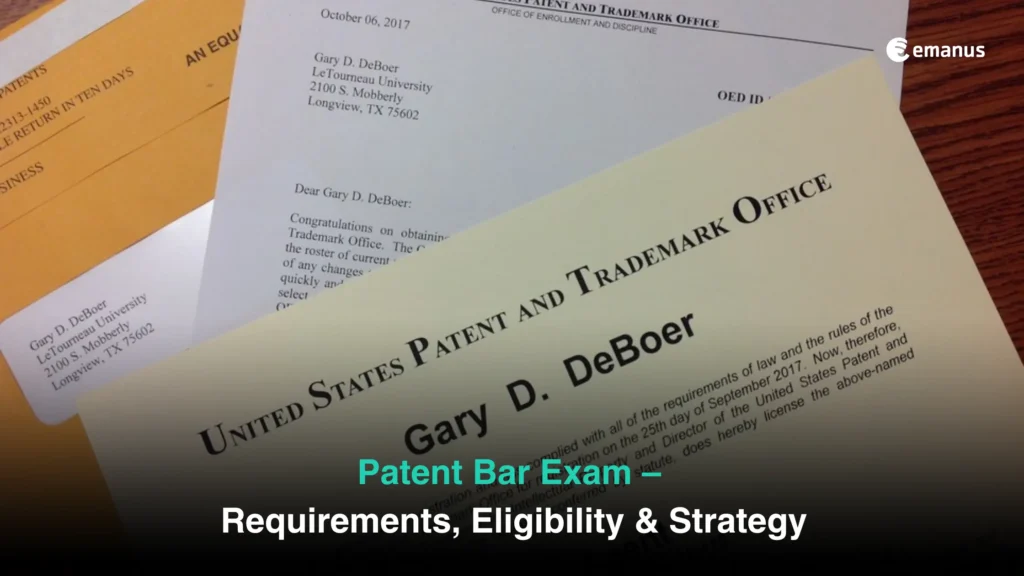
There’s a gate between you and the United States Patent and Trademark Office (USPTO). And only one key opens it.
You can hold a doctorate in bioengineering. You can have a decade of experience as a software architect.
You can be a licensed attorney.
But without passing the USPTO patent bar exam, you cannot draft or prosecute a single U.S. patent for someone else.
The patent bar exam does not care about your résumé. It cares about one thing: whether you can master its maze of rules, deadlines and procedures. Before you commit to taking it, here’s what the exam truly demands.
Things to Know:
Before you can sit for the exam, you must apply through the USPTO’s Office of Enrollment and Discipline (OED).
The core patent bar exam requirements include:
- Submit a formal application.
- Demonstrate good moral character and reputation.
- Prove you possess the required scientific or technical qualifications.
- Show competence to advise and assist patent applicants.
Most candidates qualify under Category A, meaning they hold an approved science or engineering degree. Others qualify under Category B, which requires specific technical coursework and documentation.
Processing time for admission tickets is often around 10 days, though it may take longer during peak application seasons.
Another critical reality: the patent bar exam evolves with patent law.
Major legal developments and legislative reform under the America Invents Act significantly reshaped what is tested.
Who Should Take the Patent Bar?
The patent bar is ideal for:
- Engineers who want to transition into IP law
- Scientists interested in patent drafting
- Law students planning to specialize in patent prosecution
- Technical professionals seeking higher-earning niche credentials
You do not need to attend law school to take the patent bar. Passing allows you to become a registered patent agent. If you are also licensed as an attorney, you can become a patent attorney
If you enjoy technical detail, structured rules and working closely with innovation, this path may be a strong fit.
Format
The patent bar exam is a computer-based, multiple-choice exam administered at Prometric testing centers across the United States.
Structure:
- 100 total questions
- Two sessions of 50 questions
- 3 hours per session (6 hours total)
Important format rules:
- Once the first 3-hour block ends, you cannot return to those 50 questions.
- Answers are automatically submitted when time expires.
- There is no penalty for guessing.
You must score 70% to pass. However, 10 questions are “beta” questions and do not count toward your score. This means you must answer at least 63 out of the 90 scored questions correctly.
You will not know which questions are beta questions so answer every question.
After receiving your exam ticket, you have a 90-day window to schedule and sit for the exam.
What Is Tested?
The patent bar exam primarily tests knowledge of:
- USPTO rules and procedures
- Patent prosecution strategy
- Filing deadlines and requirements
- Appeal procedures
- Patentability standards
Although older exams from 2003 are publicly available, they reflect outdated law.
Modern patent bar exam prep must focus on:
- America Invents Act changes
- Updated MPEP procedures
- Current USPTO guidance
The exam is no longer a predictable test built from recycled questions.
Pass Rate
The patent bar is widely regarded as difficult.
The overall pass rate hovers around 47%, meaning more than half of test-takers fail on their first attempt.
Why?
- The exam tests procedural nuance, not just general concepts.
- The MPEP is dense and complex.
- The law continues to evolve.
- Time pressure is significant.
Even strong engineers and scientists often underestimate how technical and detail-oriented the exam truly is.
Preparation strategy makes the difference between passing and retaking.
Study Time
Effective patent bar exam prep is intensive and structured:
- High-quality exam-level practice questions
- Timed simulations
- Deep familiarity with navigating the MPEP
A practical benchmark for serious candidates:
- Complete 700+ exam-level questions.
- Simulate full 3-hour testing blocks.
- Spend as much time reviewing answers as taking practice sets.
Most candidates need 8–12 weeks of disciplined study, depending on their familiarity with patent law.
This is not a memorization exam. It’s a navigation exam. You must learn how to quickly locate and apply the correct rules under time pressure.
Career Impact
Registered patent agents and attorneys work in:
- Intellectual property law firms
- Technology corporations
- Research institutions
- Startups
- Independent consulting
The credential often increases earning potential and career mobility, especially for those already working in innovation-driven industries.
It also builds long-term resilience. As long as innovation continues, patent professionals remain essential.
Common Queries
- How hard is the patent bar exam?
It’s challenging because it tests detailed knowledge of patent laws and USPTO procedures. Strong preparation and technical focus are key. - Who is eligible for the patent bar exam?
You must have a qualifying science or engineering degree (or equivalent coursework) and meet USPTO requirements. - Is the patent bar exam different from the bar exam?
Yes. The patent bar allows you to practice before the USPTO, while a state bar exam allows you to practice general law in court. - What is the difference between the MCAT and the patent bar exam?
The MCAT is for admission to medical school. The patent bar tests knowledge of patent law and USPTO rules. - What is the highest patent lawyer salary?
Top patent attorneys in major U.S. markets can earn $200,000–$350,000+ annually, especially with technical expertise and firm partnerships. - Which are the 3 toughest exams in the world?
Often cited are the CFA, UPSC Civil Services (India) and Gaokao (China), though difficulty depends on preparation and background. - Can you pass the patent bar without going to law school?
Yes. You can become a registered patent agent without law school if you meet the technical requirements and pass the exam.
Final Perspective
The patent bar exam is your gateway into a field that protects innovation at its earliest stage.
It demands discipline. It rewards precision.
For those who meet the patent bar exam requirements and commit to serious preparation, the reward is authority- the authority to represent inventors before the USPTO.
Innovation shapes the future. Expert patent practitioners at Emanus secure it.