

Imagine walking onto Wall Street without a single physical asset.
Just a patent. And walking out with capital.
That’s the reality of intellectual property in 2026. The old model treated IP as a legal shield. To understand how protection forms the foundation of monetization, explore our guide on startup intellectual property protection. The new model treats it as a financial engine powered by intellectual property securities.
Innovators are now packaging their ideas into tradable IP securities, letting investors buy directly into the next breakthrough, one patent at a time.
This is how it works. And why it changes everything.
What Is Intellectual Property Securitization?
Intellectual property securitization is the process of converting IP assets into tradable intellectual property securities.
In simple terms:
You own a valuable asset like a patent or a brand. Instead of selling it outright or using it as collateral for a loan, you structure it into an investment product commonly referred to as IPS (Intellectual Property Securities). Investors then buy shares linked to the IP’s future revenue.
This transforms your intellectual property from a static legal right into a dynamic capital-raising engine.
Why This Matters Now
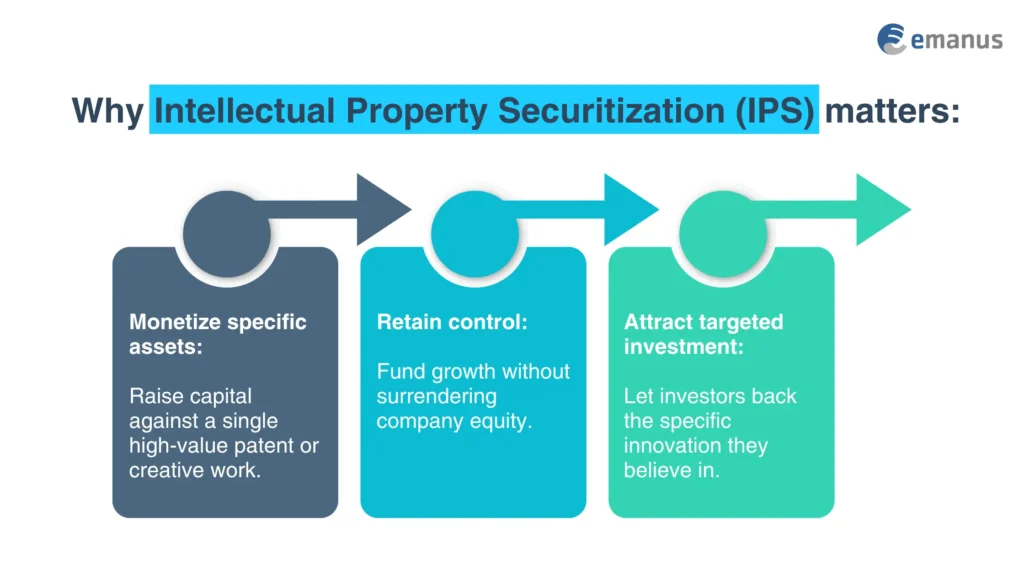
IP securitization offers a powerful alternative. It allows you to:
- Monetize specific assets: Raise capital against a single high-value patent or creative work.
- Retain control: Fund growth without surrendering company equity.
- Attract targeted investment: Let investors back the specific innovation they believe in.
The Three Primary Types of Intellectual Property Securities (IPS)
1. Intellectual Property Ownership Shares (IPOS)
These shares grant investors a direct co-ownership interest in the IP asset itself.
How it works: The IP owner structures and sells shares that represent a percentage of ownership in a patent, trademark or creative work. Investors benefit from the asset’s long-term appreciation and any revenue it generates.
Best for: High-growth patent portfolios, valuable brand trademarks and scalable technology platforms with long-term potential.
2. Intellectual Property Licensing Shares (IPLS)
These shares are tied exclusively to the income stream generated by licensing the IP.
How it works: The IP holder retains full ownership but assigns a specific stream of licensing revenue to investors. Returns are paid out from royalties, sync fees or subscription payments. For a deeper look at turning royalties into real revenue, read our IP licensing profit playbook.
Best for: Music catalogs, software licensing models, book royalties and franchised trademarks.
3. Intellectual Property Assignment Shares (IPAS)
These involve a structured investment linked to the partial or conditional transfer of specific IP rights.
How it works: For a defined period or within a specific field of use, certain rights (like the right to commercialize a drug in a specific region) are assigned to a security. Investors participate in the income or value generated from that specific assignment.
Best for: High-value pharmaceutical patents, strategic technology partnerships and monetizing underutilized assets in new markets.
The Securitization Process: A 2026 Roadmap
Creating successful IP securities requires structure:
Step 1: Identify and Prepare the IP Asset
If you are still building your protection framework, this practical guide on how to secure intellectual property can help you reduce risk before bringing IP assets to investors.
Before monetization, founders must focus on how to secure intellectual property properly:
Confirm ownership.
Ensure all legal protections (patents, copyrights, trademarks) are current. You can also review our breakdown of intellectual property services to understand the professional support available for registration, protection, and enforcement. Audit the asset’s commercialization history and potential.
Step 2: Conduct a Rigorous IP Valuation
Professional IP valuation services enhance investor confidence and improve pricing accuracy.
Key factors include:
Historical and projected revenue.
Market size and competitive landscape.
Strength and scope of legal protection..
Step 3: Structure the Security
Work with financial and legal experts to design the security:
Choose the appropriate type (IPOS, IPLS, IPAS).
Define the share structure, revenue right and term.
Ensure full compliance with securities regulations.
Step 4: Syndication and Offering
The security is offered to accredited or institutional investors through regulated channels. This is where the asset is marketed based on its unique value proposition and risk/return profile.
Step 5: Ongoing Management and Distribution
Post-issuance, the focus shifts to administration:
Tracking revenue generated by the IP.
Managing royalty collection.
Distributing returns to investors with full transparency, aided by modern digital platforms.
The Investor & Owner Advantage
For IP Owners:
Non-Dilutive Capital: Raise funds without selling equity in your core business.
Unlock Hidden Value: Monetize dormant or underutilized IP assets.
Financial Flexibility: Diversify funding sources and strengthen the balance sheet.
For Investors:
Exposure: Invest directly in the technologies and creative works shaping the future.
Portfolio Diversification: Access a return stream potentially uncorrelated with traditional stock and bond markets.
Targeted Risk: Back a specific asset with a clear value proposition, rather than a complex corporate entity.
Navigating the Challenges
This isn’t a frictionless path. Key challenges require careful navigation:
Valuation Complexity: Intangible assets are difficult to value, requiring specialized expertise.
Regulatory Hurdles: Securities laws are strict so compliance is non-negotiable.
Performance Risk: Market performance directly impacts returns.
Action tip: Before issuing IP securities, assemble a team experienced in IP law, structured finance, and professional IP valuation services.
Is This the Right Path for You?
IP securitization is a powerful tool, but not for every situation.
Consider securitization if:
- You own well-protected, high-value IP.
- Your IP generates predictable or scalable revenue.
- You have long-term strategy clarity.
Avoid it if:
- IP protection is weak or unregistered.
- Revenue projections are speculative.
- You are unprepared for compliance complexity.
FAQs
- What are the 4 types of intellectual property?
Patents (inventions), trademarks (brand names/logos), copyrights (creative works) and trade secrets (confidential business information like formulas). - What are intellectual property investments?
These are investments based on IP assets like funding a patented technology or buying rights to a music catalog to earn royalties. - What are three examples of intellectual property?
A patented AI algorithm, a registered brand logo and a copyrighted software program. - What is an example of an intellectual property asset?
A patented medical device design that generates licensing income is a valuable IP asset. - How to make money with intellectual property?
License it, sell it, franchise it, attract investors or structure it into intellectual property securities (IPS).
Final Takeaway
Ideas have always changed the world.
Now they can fund it too.
Intellectual property securitization in 2026 closes the loop between creation and capital. It lets innovators unlock resources today instead of waiting years for returns.
This is the new logic of innovation: your best ideas don’t just protect your future.
They pay for it.
Unlock full IP value today with Emanus’ securitization.