
Are you one of the founders facing the dependency dilemma? Is your brilliant idea workable only if another product exists? Great innovators don’t stay stuck- they design with freedom in mind.
If you’re improving an existing product or building on a popular platform, marketing your innovation isn’t just about features. It’s about positioning and ownership.
Whether you’re a startup founder, SME or product manager, this guide shows you how to market innovations built on existing products. Turn dependency into dominance and ensure your invention stands out.
What Are Innovations Built on Existing Products?
Not every invention starts from scratch. Many breakthrough ideas enhance, extend or complement an existing product or platform. These are called innovations built on existing products or incremental innovations.
- They improve what already works: Your innovation adds features, performance upgrades or usability improvements to a product people already use.
- They solve new problems: Even small tweaks can address unmet needs or pain points your users face.
- They stay compatible: The best innovations work seamlessly with the original product while maintaining independence.
Why Innovating Existing Products Works
Building on an existing product has massive advantages:
- Lower risk: The base product is proven.
- Faster adoption: Users are already familiar with the ecosystem.
- Investor appeal: Improvements are easier to validate than completely new products.
Examples of product innovation strategy:
- Add-on software features for popular platforms
- Hardware accessories that enhance smartphones or appliances
- New SaaS modules for enterprise tools
Understand Your Audience
Know your customers before you pitch your innovation:
- Identify pain points: Surveys, reviews and analytics reveal unmet needs.
- Segment users: Early adopters may embrace bold changes, mainstream users prefer familiarity.
- Validate assumptions: Test features on small user groups to refine messaging.
Position Your Innovation Smartly
Your messaging can make or break adoption:
- Highlight new benefits, not just tweaks.
- Show real-world impact: speed, cost savings, convenience or efficiency.
- Use storytelling to link the old product with your improvement.
This is crucial for commercializing innovation. Strong positioning must also be supported by legal safeguards — explore how trademark protection for innovations strengthens long-term brand control.
Channels to Market Innovations
Reach the right users in the right way:
- Social media campaigns targeting existing and new customers
- Email marketing to current users for upgrades
- Paid ads emphasizing unique improvements
- Product listing updates on platforms like Amazon, Shopify or App Store
Leverage Existing Brand Equity
Your base product’s reputation is a springboard:
- Showcase testimonials or case studies
- Highlight awards, certifications or expert endorsements
- Use influencer partnerships strategically
Pricing and Promotion Strategies
- Bundle offers: Pair the innovation with the original product.
- Upgrade incentives: Trade-ins or loyalty rewards
- Limited launches: Early access or exclusive editions create buzz
Measuring Success
Track results to guide future iterations:
- KPIs: Adoption rate, conversion rate, repeat purchases
- Feedback: Collect and act on user insights
- Optimization: Adjust messaging, channel and features based on performance
Dependency Dilemma: How to Stay in Control
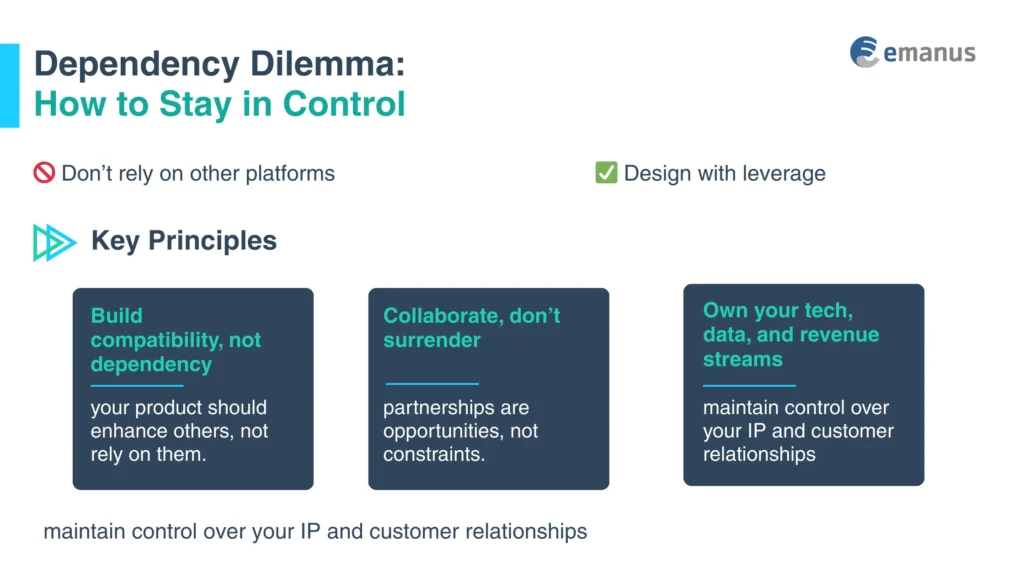
Many innovators risk building products that depend too heavily on others’ platforms. Here’s how to design with leverage:
Principles:
- Build compatibility, not dependency – your product should enhance others, not rely on them
- Collaborate, don’t surrender – partnerships are opportunities, not constraints
- Own your tech, data and revenue streams – control your IP and customer relationships
This ensures successful innovation commercialization. Understanding the IP lawyer’s role in protecting innovations ensures your enhancement remains legally defensible while scaling.
Market Leverage Self-Check
Rate your product on these points:
- Adds value beyond the existing product?
- Can it function without the base product?
- Protect your tech, data and revenue streams?
- Offers clear differentiation in the market?
Result:
- If you score 4/4, you have strong market leverage
- If you score 2-3, some adjustments are needed
- If you score 0-1, consider pivoting your innovation
FAQs
- How to innovate an existing product?
Identify pain points, add unique features, improve usability or integrate new technology while keeping compatibility with the original product. - How to penetrate the market with existing products?
Focus on clear messaging, target early adopters, and demonstrate how your product solves problems better than alternatives. - What are the 4 P’s of innovation?
Product, Process, Positioning, and Paradigm- these guide how you create, deliver and differentiate your innovation. - How to market an existing product?
Highlight enhancements, showcase benefits over the base product, leverage testimonials and use targeted digital campaigns to reach the right audience. - What is the 7-11-4 rule of marketing?
Engage your audience 7 times with one message, 11 times with varied messages and aim for 4 meaningful actions or conversions. - What is the 3-3-3 rule in marketing?
Focus on 3 main benefits, share across 3 channels and target 3 key audience segments for maximum clarity and reach. - Can you patent an improvement?
Yes. If your improvement is novel, non-obvious and useful, you can file a patent on the enhancement even if it builds on an existing product. If you’re expanding internationally, review our detailed US patent guide for Indian innovators to understand how improvement patents work in global markets.
Conclusion: Market Smarter, Not Harder
The path to marketing derivative innovation is paved with strategy. It demands a blend of audience insight, technological authority and benefit-driven storytelling. When executed right, it redefines your product as a category leader. True market innovation leverages it to create new value and command new ground.
Stop adapting. Start leading. The market rewards clarity and vision. Define yours with Emanus.